

The electric vehicle has changed the die casting furnace more in five years than the internal combustion engine did in fifty. That is not an exaggeration. When Tesla introduced the first “gigacast” rear underbody in 2019, it set off a chain reaction that has reshaped what a die casting furnace must do, how fast it must do it, and how precisely it must control the metal it delivers.
I have spent 25 years working with aluminium melting furnaces. In the last three years, I have watched foundries in China, Southeast Asia, India, and Europe completely rethink their melting and holding strategies. The EV is not just a new product. It is a new process, and the furnace is at the centre of it.
Here is what is actually changing, and what it means for foundries supplying the EV supply chain.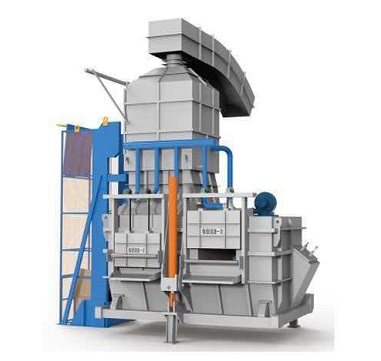
The Gigacast Problem: More Metal, Faster, Hotter
Traditional die casting delivers 5 to 20 kg of metal per shot. A gigacast machine delivering a single-piece rear underbody or battery tray can require 100 to 200 kg per shot. At Dongfeng’s integrated die casting facility in Wuhan, the 16,000-tonne machine completes a full cycle — injection, clamping, pressurising, cooling — in 135 seconds, producing a battery tray with a 95% qualification rate.
That is the furnace problem in one sentence. You cannot deliver 200 kg of aluminium at 700°C with a ladle and a forklift. The metal must be melted, held, treated, transferred, and dosed at a rate and precision that legacy furnace systems were never designed for.
The response has been in-cell melting — moving the melting and holding furnace directly into the casting cell. StrikoWestofen’s LeanMelter and comparable systems from Chinese manufacturers like Sanken Sangyo integrate shaft melting, holding, treatment, and dosing into a single compact unit. The furnace is no longer a separate department. It is part of the die casting machine.
I visited a foundry in Guangdong in 2024 that had commissioned an in-cell system for EV battery housing production. The metal was transferred from melt to shot sleeve in under 90 seconds. Metal loss was measured at 0.06%. That is not incremental improvement. That is a different class of equipment.
Vacuum Is No Longer Optional
A structural EV casting — a battery enclosure, a motor housing, a front shock tower — must pass leak testing. A helium leak test at the Tier 1 level does not forgive porosity.
Legacy HPDC operates at ambient pressure. The new standard for EV structural parts is vacuum-assisted HPDC, with vacuum levels in the 50–150 mbar range. That vacuum must be maintained during the entire shot profile, from slow shot through intensification.
The furnace’s role in this is not passive. The metal must arrive at the shot sleeve at the correct temperature, with the correct hydrogen content, and with minimal oxide inclusion. If the furnace delivers metal that is too hot, gas absorption increases. Too cold, and the vacuum cannot compensate for incomplete fill.
I have seen foundries in Southeast Asia try to run vacuum HPDC with legacy holding furnaces and wonder why their leak test rejection rate is 8%. The furnace was the problem. The vacuum system was fine. The metal quality was not.
The practical solution is a dosing furnace with integrated degassing and temperature control, connected directly to the vacuum-assisted shot sleeve. This is not a standard product in most Chinese furnace catalogues yet. But the top-tier suppliers are offering it, and the foundries that have adopted it are seeing leak rejection rates below 1%.
Thermal Precision: From ±15°C to ±3°C
EV castings are large, thin-walled, and structurally critical. A battery tray wall may be as thin as 2.5–5 mm, compared to 4–8 mm for conventional HPDC parts-48. The metal must fill a complex geometry without cold shuts, without turbulence-induced oxides, and without warpage that ruins CNC setup.
That demands temperature control that legacy furnaces cannot deliver. A standard gas-fired holding furnace swings ±10–15°C. An electric dosing furnace can hold ±3°C. The difference is not cosmetic. It is the difference between a part that passes leak test and a part that does not.
The market has responded. StrikoWestofen’s Westomat dosing technology, when replacing gas-fired holding furnaces, achieved energy savings of up to 30% while eliminating combustion CO₂ emissions-. The Westomat 4300 Duo, designed for gigacast volumes, holds large melt volumes with the same dosing precision as smaller models.
Chinese furnace manufacturers are following. Sanken Sangyo, based in Shenyang, has developed large holding furnace solutions specifically for integrated die casting, with melting capacities from 100 kg to 7,000 kg per hour-. The technology is there. The question is whether mid-tier foundries can justify the investment.
Energy and Emissions: The EV Paradox
The EV is supposed to be cleaner than the internal combustion vehicle. But the aluminium casting that goes into an EV is energy- and carbon-intensive. In China, the aluminium casting industry contributed approximately 1.1% of national carbon emissions in 2020. The molten aluminium supply system — melting, holding, treatment, transfer — accounts for approximately 60% of manufacturing energy consumption and nearly 70% of direct carbon emissions in aluminium casting-.
The EV supply chain cannot ignore that. European OEMs are already requiring carbon footprint data from their Tier 1 and Tier 2 casting suppliers. The EU’s CBAM adds a cost to imported aluminium products based on embedded emissions.
The furnace is the first place to look. A modern electric holding and dosing furnace eliminates combustion emissions entirely. A shaft melting furnace with recuperative burner technology can achieve specific energy consumption below 500 kWh/t-. A legacy gas-fired reverb furnace can consume twice that.
I have seen foundries in India and Vietnam resist the switch to electric holding because electricity costs more per kWh than gas. That calculation is incomplete. It ignores metal loss, temperature stability, and the cost of rejected parts. When you add those in, the electric furnace often wins.
Automation: The Furnace Becomes a Data Source
The EV supply chain demands traceability. Every casting must be linked to a specific melt, with documented chemistry, temperature, and treatment history. A furnace that logs data manually is a liability.
Modern dosing furnaces come with PLC controls that log every shot: metal temperature, dosing weight, cycle time, and alarm events. This data feeds into the MES system and becomes part of the PPAP documentation that Tier 1 auditors review-48.
The leading Chinese suppliers have recognised this. The top-tier furnaces now offer OPC UA connectivity, remote monitoring, and predictive maintenance alerts. A foundry manager in Thailand can check the dosing accuracy of a furnace in Rayong from a phone in Bangkok.
That is not a luxury feature for EV work. It is becoming a baseline requirement. If your furnace cannot tell you what happened in the last shot, you cannot prove that your part is safe.
What This Means for Foundries in Southeast Asia and India
The EV transition is not evenly distributed. Thailand and Indonesia are becoming regional EV manufacturing hubs. India is building domestic EV capacity. Vietnam is attracting Tier 1 suppliers.
For foundries in these markets, the furnace decision is now a strategic one. A legacy gas furnace that was adequate for ICE parts will not pass EV leak testing at the required rate. A holding furnace without dosing precision will not keep up with a 135-second cycle.
The Chinese furnace manufacturers have an advantage here. They have already supplied in-cell melting and dosing systems to Chinese EV makers like Dongfeng and BYD. They understand the cycle times and quality requirements. And they can deliver at 20–40% below European prices.
But the risk is real. A Chinese furnace with no local service presence is a gamble. I always tell my clients: if you buy a Chinese system for EV work, insist on a local commissioning engineer, a local spare parts stock, and a reference site you can visit. The equipment may be excellent. The support must match it.
A Real Case from Thailand
In 2024, a die casting plant in Rayong, Thailand, was awarded a contract for EV motor housings. Their existing gas-fired holding furnaces could not meet the leak test requirement. Rejection rate was 9%.
We evaluated three options: a European electric dosing furnace, a Chinese electric dosing furnace, and a hybrid approach with a new gas melter and electric holder.
They chose the Chinese electric dosing furnace. The supplier had a service engineer in Bangkok and a spare parts warehouse in Laem Chabang. Commissioning took three weeks.
Six months later, the rejection rate was 1.8%. Cycle time had dropped from 150 seconds to 138 seconds. Energy consumption per tonne was 22% lower than the gas furnace they replaced.
The furnace cost 35% less than the European option. The payback period was 14 months.
Final Thoughts
The EV has forced the die casting furnace to evolve faster than at any point in my 25-year career. The requirements are now: more metal, faster, hotter, cleaner, with vacuum compatibility and full data traceability.
The furnaces that meet these requirements are not the furnaces that most foundries currently own. The gap between a legacy gas holding furnace and an EV-ready electric dosing system is enormous — in temperature control, in metal loss, in energy consumption, and in the data it produces.
For foundries supplying the EV supply chain, the furnace is no longer a supporting asset. It is a critical path item. The ones who recognise this early will win the contracts. The ones who delay will find themselves unable to qualify.
In my experience, the foundries that succeed in this transition are not the ones with the biggest budgets. They are the ones that ask the right questions before they buy. Define your leak test requirement. Define your cycle time. Define your traceability need. Then choose the furnace that meets it.
The EV is not going away. The furnace is changing. The question is whether your foundry is changing with it.
Internal links: The State of China’s Aerospace Aluminium Melting Industry – Expert Analysis, The State of the Aluminium Recycling Industry in China – Expert Analysis
About the Author: Hu Shenyue is a veteran aluminium melting furnace expert with 25 years of hands-on experience in China, Southeast Asia, India, the UK, and Europe. He writes practical, experience-based content on furnace selection, maintenance, and optimisation at SmeltPro.