

Choosing a secondary aluminium melting furnace for ingot production is not about buying the biggest furnace or the one with the lowest price. It is about matching the furnace to your feedstock, your energy source, and your production target. Get one wrong, and you will pay for it in metal loss, downtime, and energy costs for the next 10–15 years.
In my 25 years, I have seen secondary aluminium plants lose anywhere from 2% to 18% of their metal input. I have also seen plants achieve 99.75% metal yield with the right furnace and the right operation. The difference is rarely the furnace brand. It is the selection process.
Here is how I approach furnace selection for secondary aluminium ingot production, based on what I have seen work — and fail — in China, Southeast Asia, India, the UK, Europe, and North America.
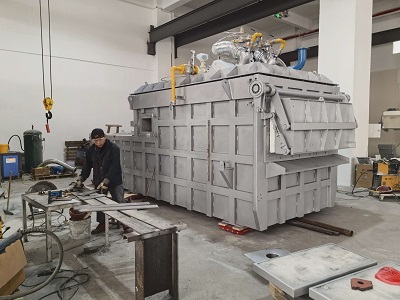
Side Well Furnace Fabrication Site
Start with Your Feedstock, Not the Furnace
The single most important factor in furnace selection is the material you will melt. Secondary aluminium covers a wide spectrum, from clean extrusion offcuts to oily turnings to dross.
Different furnace types are designed for different feedstock characteristics. A furnace that works well for clean ingot will struggle with contaminated scrap. A furnace that handles dross economically may be overkill for clean returns.
| Feedstock Type | Typical Contamination | Recommended Furnace |
|---|---|---|
| Clean ingot, T-bars, sows | Low | Reverberatory, stack melter |
| Extrusion offcuts, profiles | Low to medium | Reverberatory, twin-chamber |
| Used beverage cans (UBC) | Medium (coatings, moisture) | Rotary, stack melter with pre-treatment |
| Turnings, chips | High (oil, moisture) | Rotary, twin-chamber with salt flux |
| Dross, sweated pig | Very high | Rotary with salt flux |
| Mixed post-consumer scrap | Variable | Rotary or twin-chamber |
The rule I give every client: define your feedstock before you talk to a supplier. A furnace salesman will sell you what they have. If you do not know what you need, you will buy the wrong thing.
Research on aluminium scrap melting confirms this. Furnace selection depends on the initial metal content in the scrap, type and content of impurities, geometry of the scrap, frequency of alloy changes, operating conditions, energy cost, and desired product quality. These are the variables that determine whether a reverb furnace or a rotary furnace is the right choice.
Match Furnace Type to Feedstock and Scale
The three main furnace types for secondary aluminium melting are reverberatory, rotary, and induction. Each has a specific role.
Reverberatory Furnace
The reverb furnace is the workhorse of large-volume secondary aluminium production. In the United States, 95% of aluminium scrap is melted in gas reverberatory furnaces. They are simple to operate and maintain, and they can handle capacities up to 150 tonnes per day.
But reverb furnaces have limitations. They operate with lower energy efficiency — 20–30% in some designs — and they are less tolerant of contaminated feedstock. They also generate higher oxidation losses, typically 3–5%, compared to rotary or induction furnaces.
Best for: Clean scrap, large-volume production, plants where simplicity and low capital cost matter.
Rotary Furnace
The rotary furnace is the choice for contaminated scrap, dross, and mixed feedstock. It handles material that would choke a reverb furnace. In Europe, rotary furnaces are more common than reverberatory furnaces for this reason.
The trade-off is salt consumption. Rotary furnaces require salt flux for low-grade scrap, generating 200–400 kg of salt slag per tonne of processed material. That salt slag must be treated and disposed of, which adds cost and environmental burden.
Best for: Contaminated scrap, dross processing, mixed feedstock, plants with salt slag treatment capability.
Induction Furnace
The induction furnace offers the highest metal yield and the lowest oxidation loss — typically below 1%. It provides excellent composition control and produces a clean melt. Energy efficiency is over 90%.
The limitations are capacity and cost. Induction furnaces are typically limited to 10 tonnes per day or less, and electricity is often more expensive than fossil fuels. They are best suited for specialty alloys and high-purity applications.
Best for: High-purity alloys, small-volume production, plants with low-cost electricity, specialty ingot production.
| Parameter | Rotary Furnace | Reverberatory Furnace | Induction Furnace |
|---|---|---|---|
| Main application | Mixed/contaminated scrap | Large-scale clean scrap | High-purity/specialty alloys |
| Typical capacity (t/day) | 20–80 | Up to 150 | ≤10 |
| Energy demand (MWh/t Al) | 0.7–1.0 | 1.1–1.4 | 0.5–0.7 |
| Metal yield (%) | 88–92 | 90–95 | 95–98 |
| Oxidation loss (%) | 2–4 | 3–5 | <1 |
| Salt slag generation (kg/t) | 200–400 | Minimal | None |
| CO₂ emissions (t CO₂/t Al) | 0.6–0.8 | 0.9–1.1 | 0.2–0.3 (renewable) |
| Key advantage | Handles contaminated scrap | High productivity | Excellent composition control |
| Main limitation | Salt flux requirement | High oxidation loss | Limited capacity, high cost |
Energy Consumption: The Number That Determines Your Operating Cost
Energy is the largest operating cost in secondary aluminium melting. The specific energy consumption (SEC) of your furnace will determine your cost per tonne for the next decade.
Modern shaft or stack melting furnaces can achieve 525–650 kWh per tonne under well-optimised conditions. Legacy reverb furnaces often run at 1,000–1,200 kWh/t. That is a 45% difference.
| Furnace Type | Typical SEC (kWh/t) | Best Achievable |
|---|---|---|
| Legacy gas reverb | 1,000–1,200 | — |
| Modern gas reverb | 800–1,000 | 700 |
| Stack/shaft melter | 525–650 | 500 |
| Rotary (with heat recovery) | 700–900 | 600 |
| Induction | 500–700 | 450 |
On a plant melting 20 tonnes per day, the difference between 1,100 kWh/t and 600 kWh/t is over $150,000 per year in energy costs. That is why SEC must be a contractual guarantee, not a brochure claim.
One study on a circulating aluminium liquid all-electric melting furnace reported pure electric melting energy consumption of 340 kWh/t with an aluminium burn-off rate of 0.9%-. That is the benchmark for electric melting. But electricity costs vary by region, so the economic comparison is not always straightforward.
Metal Recovery: The Hidden Profit Driver
Metal loss in secondary aluminium melting is not a single problem. It is a chain of losses — oxidation at the melt surface, metal trapped in dross, salt slag carryover, and furnace atmosphere reactions.
Oxidation losses during remelting typically range from 1–3% for clean wrought alloys to 5–8% for contaminated or heavily oxidised scrap. Net metal recovery from mixed post-consumer scrap rarely exceeds 85–90% under conventional processing.
The furnace you choose determines where you land in that range. A well-designed stack melter can achieve metal loss below 1.5%, typically less than 1%. A poorly operated reverb furnace can lose 5% or more.
I have written about how to reduce metal loss in secondary aluminium melting in detail. The principles apply to every furnace type.
Ingot Casting Line Integration
The furnace is only one part of the ingot production system. The casting line — the moulds, cooling system, conveyor, and stacking equipment — must be matched to the furnace output.
The furnace and the casting line must be specified together. A reliable ingot casting line should have:
Consistent metal delivery and temperature control
Mould condition monitoring and preheating
Cooling arrangement matched to alloy and ingot size
Speed control for different ingot formats
Safe discharge and stacking
I have seen foundries buy a good furnace and a cheap casting line. The result is inconsistent ingot weight, surface defects, and customer complaints. The casting line is not an accessory. It is part of the melting system.
I have written about how to optimize an aluminium ingot casting line — the principles are directly applicable to secondary aluminium plants.
Supplier Evaluation: Beyond the Brochure
The Chinese furnace market has matured. The top-tier manufacturers now produce equipment that matches European efficiency at 20–40% lower cost. But the gap between the top 10% and the rest is enormous.
I have written a detailed guide on how to evaluate the reliability of Chinese aluminium furnace manufacturers. For secondary aluminium ingot production, the key questions are:
Reference sites processing similar feedstock — not just any reference, but one with your scrap type.
Local service engineers — how many, where, and response time.
Spare parts warehouse — what is stocked locally, lead times for critical parts.
Salt slag handling experience — if you are using a rotary furnace, this is critical.
Performance guarantee — SEC, metal recovery rate, melt rate, salt consumption.
Contract terms — warranty, acceptance criteria, penalties.
A supplier who cannot answer these clearly is not ready for secondary aluminium work.
A Real Case from Malaysia
In 2023, a secondary aluminium plant in Johor was producing ADC12 ingots for export to Japan and South Korea. Their metal loss was 12.8%. They were skimming every 20 minutes. The furnace was running at 760°C. Scrap was stored outdoors and charged wet after rain.
We made four changes:
Lowered the melt temperature from 760°C to 720°C.
Changed skimming frequency from every 20 minutes to every 45 minutes, with a dross press.
Built a covered drying rack for scrap. No more wet charging.
Added a cover flux during holding.
Results after one month:
| Metric | Before | After | Improvement |
|---|---|---|---|
| Metal loss | 12.8% | 7.4% | 5.4% reduction |
| Dross metal content | 42% | 26% | 16% reduction |
| Energy consumption | 890 kWh/t | 756 kWh/t | 15% reduction |
| Annual metal savings | — | $340,000 | — |
| Investment | — | $8,500 | Payback: 1 week |
The furnace was not replaced. It was optimised. That is often the first step before considering a new furnace.
A Simple Selection Checklist
Define your feedstock: clean, mixed, or contaminated.
Match furnace type: reverb for clean, rotary for contaminated, induction for specialty.
Calculate required capacity based on daily tonnes and operating schedule.
Specify SEC: target 525–650 kWh/t for modern furnaces.
Require metal recovery guarantee: 90%+ for clean, 85%+ for mixed.
Integrate the casting line: moulds, cooling, conveyor, stacking.
Evaluate supplier: reference sites, local service, spare parts, guarantees.
Calculate total cost of ownership over five years.
Visit a reference site with similar feedstock.
Get the performance guarantee in writing.
Final Thoughts
Choosing a secondary aluminium melting furnace for ingot production is a system design problem, not a procurement transaction. The furnace must match your feedstock, your energy source, and your production target.
In my 25 years, I have seen plants succeed with reverb furnaces and fail with rotary furnaces. I have seen the opposite. The difference is not the furnace type. It is the thinking behind the selection.
Start with the feedstock. Then match the furnace. Then integrate the casting line. Then evaluate the supplier. You will get a furnace that lasts — and a process that wins.
Internal links: How to Reduce Metal Loss in Secondary Aluminium Melting for Ingot Production,The State of the Aluminium Recycling Industry in China – Expert Analysis.
About the Author: Hu Shenyue is a veteran aluminium melting furnace expert with 25 years of hands-on experience in China, Southeast Asia, India, the UK, and Europe. He writes practical, experience-based content on furnace selection, maintenance, and optimisation at SmeltPro.