

Choosing an energy-efficient aluminium melting furnace comes down to four things: specific energy consumption, furnace type, heat recovery, and control system. Get these right, and you cut your energy bill by 20–40%. Get them wrong, and you pay for it every day for the next 15 years.
I have spent 25 years selecting, installing, and troubleshooting aluminium melting furnaces in China, Southeast Asia, India, the UK, Europe, and North America. In the last three years, energy efficiency has moved from a “nice to have” to the first question every buyer asks. Here is how I answer it.
Start with Specific Energy Consumption — Not Price
The single most important number in furnace selection is specific energy consumption (SEC) — the energy required to melt one tonne of aluminium. It is measured in kWh per tonne for electric furnaces, or m³ per tonne for gas furnaces.
Modern aluminium melting systems can achieve 550–650 kWh per tonne under well-optimised conditions. Legacy furnaces often run at 1,000–1,200 kWh per tonne. That is a 45% difference.
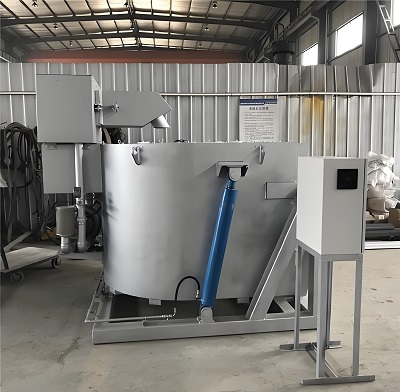
| Furnace Type | Typical SEC (kWh/t) | Best Achievable |
|---|---|---|
| Legacy gas reverb | 1,000–1,200 | — |
| Modern gas reverb | 650–800 | 550 |
| Tower/Shaft furnace | 550–700 | 500 |
| Electric resistance | 600–750 | 550 |
| Induction | 550–700 | 500 |
| Rotary (with heat recovery) | 700–900 | 600 |
On a 2-tonne-per-day foundry, the difference between 1,100 kWh/t and 600 kWh/t is $50,000–$80,000 per year in energy costs alone. That is why SEC is the first question I ask every supplier.
If a supplier cannot provide a guaranteed SEC figure in the contract, walk away. A furnace without a guaranteed energy figure is a gamble.
Match Furnace Type to Your Process
Not all furnace types are equally efficient. The right choice depends on your alloy, your scrap quality, and your production schedule.
Tower/Shaft furnaces are the most efficient for continuous melting. They use the exhaust gas to preheat the charge as it descends through the shaft. The result is SEC as low as 500–550 kWh/t. But they require consistent scrap size and a continuous production schedule.
Electric resistance furnaces are highly efficient for holding and small-batch melting. They have no combustion losses. But electricity costs more per kWh than gas in most markets.
Induction furnaces offer excellent efficiency and precise temperature control. They are the standard for high-purity alloys and aerospace work.
Rotary furnaces are less efficient in absolute terms but excel at processing contaminated scrap. With heat recovery, they can reach 700–800 kWh/t.
Reverberatory furnaces vary widely. A modern design with a recuperative burner can achieve 650–750 kWh/t. A legacy furnace with no heat recovery can exceed 1,100 kWh/t.
I wrote a detailed guide on how to choose the right aluminium melting furnace. The efficiency trade-offs are part of that decision.
Look at the Burner System
The burner is where the energy enters the furnace. A poorly tuned burner wastes 10–20% of the fuel. A well-designed burner system captures that back.
Regenerative burners use a pair of burners that alternate between firing and recovering heat from the exhaust. They can preheat combustion air to 900–1,000°C, achieving thermal efficiencies above 80%. The upfront cost is higher, but the payback is often under two years.
Recuperative burners use a heat exchanger to preheat combustion air to 400–600°C. They are simpler and cheaper than regenerative systems. Every 100°C of preheat improves efficiency by about 5%.
Oxygen-enhanced combustion can reduce fuel consumption by up to 60% in laboratory testing. The optimal oxygen concentration is 35% by volume. Beyond that, fuel savings are marginal while NOx emissions rise.
I have written about how to optimise burner efficiency in detail. The principles apply to every furnace type.
Evaluate Heat Recovery Potential
The exhaust gas from an aluminium melting furnace leaves at 800–1,000°C. That heat is money going up the stack.
Recuperators capture exhaust heat and use it to preheat combustion air. A good recuperator can preheat air to 400–500°C, saving 15–20% on gas.
Scrap preheating uses exhaust gas to preheat the charge before it enters the furnace. This drives off moisture and reduces the energy needed to melt. One study found that exhaust heat can preheat scrap to 482–538°C and combustion air to 427–482°C simultaneously.
Regenerative systems go further, capturing up to 85% of exhaust heat. They are standard on modern tower furnaces.
I installed a recuperator on a 2-tonne reverberatory furnace in Malaysia. The payback was 11 months. After that, the foundry saved over $18,000 per year in gas costs.
Check the Control System
A furnace with manual controls is like a car without a speedometer. You do not know how fast you are going until you crash.
Modern control systems use oxygen trim, temperature feedback, and variable speed drives. They adjust the air-fuel ratio automatically as conditions change. This keeps efficiency high even when gas quality or production rate varies.
The key features to look for:
Oxygen trim — measures O₂ in flue gas and adjusts air damper automatically
Temperature control — PID or model predictive control, not on/off
Data logging — records energy consumption per tonne, temperature, and alarms
Remote monitoring — allows supplier to diagnose issues without a site visit
I have seen foundries save 10–15% just by adding oxygen trim. The investment pays back in months.
AI-based optimisation has shown energy savings of up to 18.5% in production environments. But I have also seen foundries buy advanced controls they never use. Start with the basics. Add AI when your team is ready.
Calculate Total Cost of Ownership — Not Purchase Price
Purchase price is irrelevant. What matters is total cost of ownership over five years:
- Purchase price
- Installation cost
- Energy cost per tonne
- Maintenance and spare parts
- Lining replacement
- Downtime cost
I have seen furnaces that were 30% cheaper upfront cost 50% more to run. The expensive furnace was actually the cheaper one.
A foundry in Vietnam was quoted 550 kWh/t by one supplier and 750 kWh/t by another. The cheaper furnace used more energy. Over five years, the difference was $120,000. The “cheaper” furnace was actually more expensive.
A Real Case from India
In 2024, a die casting plant in Pune asked me to help select a new furnace. They were melting 2 tonnes per day of ADC12. Their old gas-fired furnace was inefficient.
We analysed energy costs, melt cycle, and future growth. They needed 3 tonnes per day within two years. We recommended a 2-tonne twin-chamber furnace with a recuperative burner.
The result: energy consumption dropped 22%. Melt loss reduced by 15%. And they had capacity to grow without buying a second furnace.
The furnace cost 15% more than the cheapest quote. The payback period was 14 months. After that, the savings went straight to the bottom line.
A Simple Checklist for Energy-Efficient Furnace Selection
Ask for guaranteed specific energy consumption (kWh/t or m³/t).
Match furnace type to your process — tower, electric, induction, rotary, or reverb.
Specify regenerative or recuperative burners for gas furnaces.
Require heat recovery — recuperator or scrap preheating.
Specify oxygen trim and PID temperature control.
Require data logging for energy consumption per tonne.
Calculate total cost of ownership over five years.
Visit a reference site with similar operating conditions.
Check spare parts availability and local service.
Get the performance guarantee in writing.
Final Thoughts
Energy efficiency is not a luxury. It is the single biggest operating cost in most foundries. Choosing a furnace without a guaranteed SEC figure is like buying a car without knowing the fuel consumption.
In my 25 years, I have seen foundries cut energy costs by 20–40% by selecting the right furnace and the right options. They paid more upfront. They saved more over time.
If you are buying a furnace, start with the SEC. Then look at the burner. Then the heat recovery. Then the controls. You will see the difference in your first energy bill.
Internal links: How to Choose the Right Aluminium Melting Furnace, Aluminium Melting Furnace Buying Guide 2026, How to Optimize Burner Efficiency in Gas-Fired Aluminium Furnaces
About the Author: Hu Shenyue is a veteran aluminium melting furnace expert with 25 years of hands-on experience in China, Southeast Asia, India, the UK, and Europe. He writes practical, experience-based content on furnace selection, maintenance, and optimisation at SmeltPro.