


In late 2022, I received an email from a foundry manager in Indiana, USA. He had found my blog through a search for “aluminium furnace maintenance checklist.” His message was short: “Our maintenance costs are out of control. We run two gas-fired reverb furnaces. Last year we spent $210,000 on repairs and parts. We need help.”
I work mostly in China, Southeast Asia, India, the UK, and Europe. But I have clients in North America. I told him I could start with a remote review. If that wasn’t enough, I would fly over.
The remote review took two weeks. The site visit took four days. By the end of the following quarter, their annualised maintenance cost had dropped to $112,000. That is a 47% reduction. Their unplanned downtime fell from 190 hours per year to 52 hours.
This is how we did it — and what any foundry can learn from it.
The Starting Point: Reactive Maintenance and Rising Costs
The foundry runs two 3-tonne gas-fired reverberatory furnaces. They melt around 15 tonnes per day of A380 and ADC12 for automotive castings. The equipment was 11 years old. It had been well-built originally. But maintenance had become reactive.
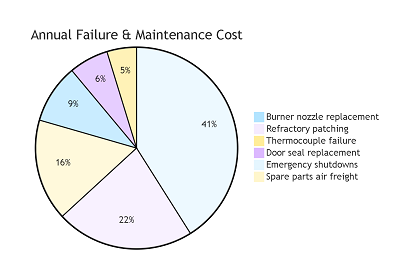
The maintenance manager showed me their records. The pattern was clear:
| Problem | Frequency | Cost per Year |
|---|---|---|
| Burner nozzle replacement | Every 6 weeks | $18,000 |
| Refractory patching | Every 3 months | $42,000 |
| Thermocouple failure | Every 2 months | $9,000 |
| Door seal replacement | Every 4 months | $12,000 |
| Emergency shutdowns | 22 events | $78,000 |
| Spare parts air freight | 14 shipments | $31,000 |
| Total | $190,000 |
That did not include lost production. The plant manager estimated each shutdown cost $4,500 in lost output. Twenty-two shutdowns meant another $99,000. The true cost was closer to $289,000 per year.
I told him: “You don’t have a maintenance problem. You have a root cause problem. You are treating symptoms.”
Step 1: Burner Tuning — The Root of Many Failures
The first thing I asked for was a flue gas analysis. They didn’t have an analyser. I asked them to borrow one or buy a basic unit. They bought a portable analyser for $1,200.
The readings were shocking:
Oxygen: 8.2%
Carbon monoxide: 85 ppm
Flue temperature: 880°C after the recuperator (which was partially blocked)
The burners were running far too lean. Too much excess air. That cools the flame, wastes gas, and causes incomplete combustion. The soot and carbon build-up were clogging the nozzles. That’s why they were replacing them every six weeks.
We spent a full day tuning both burners. We cleaned the nozzles, adjusted the air dampers, and re-set the gas pressure. We also cleaned the recuperator, which had been neglected for years.
The result: O₂ dropped to 3.1%. CO dropped to 22 ppm. Flame colour changed from yellow to blue.
Immediate impact: Burner nozzle life extended from 6 weeks to 4 months. Annual saving: $12,000.
Step 2: Refractory Repair — Stop Patching, Start Fixing
The maintenance team was patching refractory cracks with mortar every three months. The patches failed. They patched again. The cycle repeated.
I inspected the lining. The cracks were not random. They were concentrated near the burner ports and the metal line. The cause was flame impingement and thermal shock.
We did three things:
Realigned the burners. The flames were hitting the sidewall instead of the bath. A simple adjustment.
Cut out the cracked sections. We removed the loose refractory and cast a proper patch using a low-cement castable. The team had been smearing mortar over the surface. That never works.
Changed the heat-up schedule. The furnace was being heated from cold to 750°C in three hours. The recommended schedule was eight hours. We slowed it down.
Result: Refractory patching frequency dropped from every 3 months to every 14 months. Annual saving: $28,000.
I have written a detailed guide on how to diagnose and repair furnace refractory cracking. The principles apply to any foundry.
Step 3: Thermocouple and Control Calibration
The thermocouples were failing every two months. The maintenance team replaced them without checking the root cause.
I checked the controller. It was configured for a type K thermocouple. The installed sensors were type K. That was correct. But the input filter was set to 60 Hz. The plant power supply was 60 Hz. It should have been set to 50 Hz or “auto.” The controller was picking up electrical noise from the nearby induction equipment.
We changed the filter setting. We also added a simple shielded cable for the thermocouple wiring.
Result: Thermocouple life extended from 2 months to 12 months. Annual saving: $7,500.
Step 4: Spare Parts Inventory — Stop Paying Air Freight
The foundry was ordering critical parts from Europe and China as needed. That meant air freight, customs delays, and premium prices.
I reviewed their failure history. The critical parts were:
- Burner nozzles
- Thermocouples
- Door seals
- Refractory castable
- Flame sensors
We built a simple min-max inventory. For each part, we set a minimum stock level and a reorder point. The initial investment was $6,500. But it eliminated 14 air freight shipments per year.
Result: Annual saving on freight and expediting: $24,000.
I always tell clients: “If a part fails more than once a year, keep one on the shelf.”
Step 5: Preventive Maintenance Schedule
The foundry had no formal preventive maintenance schedule. They fixed things when they broke.
We created a simple checklist — daily, weekly, monthly, quarterly. It was one page, not a 50-page manual. The operators could actually use it.
The daily checks included:
- Flame colour
- Gas pressure
- Temperature reading
- Door seal condition
- Unusual noises
The weekly checks included:
- Clean burner nozzle
- Inspect refractory
- Check thermocouple wiring
- Test safety interlocks
The monthly checks included:
- Calibrate thermocouples
- Inspect recuperator
- Check electrical connections
- Review error logs
Result: Unplanned downtime dropped from 190 hours to 52 hours per year. Annual saving in lost production: $62,000.
I have published a full furnace maintenance checklist. It is free to use. Adapt it to your equipment.
Step 6: Operator Training
The night shift was causing most of the problems. They were charging wet scrap, overcharging the furnace, and skipping daily checks.
We spent two days training all operators. Not theory. Just practical things:
- How to check flame colour
- How to charge scrap properly
- How to record data
- Why daily checks matter
The plant manager added a simple incentive: a monthly bonus if no unplanned shutdowns occurred. That changed behaviour quickly.
Result: Operator-related errors dropped by 80%. Annual saving: $18,000.
The Results After Six Months
| Metric | Before | After | Improvement |
|---|---|---|---|
| Annual maintenance cost | $190,000 | $112,000 | 41% reduction |
| Unplanned downtime | 190 hours | 52 hours | 73% reduction |
| Burner nozzle life | 6 weeks | 4 months | 3x longer |
| Refractory patch frequency | Every 3 months | Every 14 months | 4.7x longer |
| Thermocouple life | 2 months | 12 months | 6x longer |
| Air freight shipments | 14 per year | 0 | Eliminated |
| Total annual saving | — | $147,000 | — |
| Investment | — | $14,200 | Payback: 5.2 weeks |
The plant manager called me six months later. He said, “We just had our first quarter with zero unplanned shutdowns. I didn’t think that was possible.”
What Made the Difference
This was not a complex engineering project. It was disciplined maintenance.
The three biggest wins were:
Burner tuning — saved $12,000 and stopped the nozzle replacement cycle.
Proper refractory repair — saved $28,000 by fixing the cause, not the symptom.
Preventive maintenance — saved $62,000 in lost production.
None of these required new equipment. They required attention, measurement, and consistency.
What You Can Apply
If you run a foundry, ask yourself:
- When did you last tune your burners with a flue gas analyser?
- Are you patching refractory or repairing it properly?
- Do you have a min-max inventory for critical spares?
- Is your preventive maintenance schedule actually followed?
- Are operators trained on daily checks?
If the answer to any of these is “no” or “I’m not sure,” you are leaving money on the table. I have seen it in every market I work in — China, Southeast Asia, India, the UK, Europe, and North America.
When to Call an Expert
You can do this yourself. But sometimes an outside eye finds things you miss. The Indiana foundry had a competent maintenance team. They were just too close to the problem.
My fee for the remote review and four-day site visit was $9,500. The annual saving was $147,000. That is a 15x return.
If your maintenance costs are rising, and you have not done a root cause analysis, call someone. Or use the checklists on this blog and do it yourself. Either way, do not wait.
Final Thoughts
Reducing maintenance costs is not about buying new equipment. It is about understanding why things fail. In this case, the failures were caused by burner misadjustment, improper refractory repair, electrical noise, and missing preventive maintenance.
Fix the causes. The costs will fall.
In my 25 years, I have seen this pattern repeat in foundries across the world. The biggest savings are often hiding in plain sight — in the burner, in the flue, in the door seal, in the charging practice.
Start with the burner. Then fix the refractory. Then build a spare parts inventory. Then train the operators. You will see the difference in your first quarter.
Internal links: Furnace Maintenance Checklist, How to Optimize Burner Efficiency in Gas-Fired Aluminium Furnaces
About the Author: Hu Shenyue is a veteran aluminium melting furnace expert with 25 years of hands-on experience in China, Southeast Asia, India, the UK, and Europe. He writes practical, experience-based content on furnace selection, maintenance, and optimisation at SmeltPro.