


In early 2024, I received a call from a foundry manager in Guangdong Province. His plant supplies aluminium die castings to several automotive OEMs in China and Southeast Asia. Their main product is a structural component for electric vehicles — a motor housing that must pass leak testing at 0.5 bar.
Their porosity rejection rate had risen to 12%. The customer had issued a warning: improve within three months, or lose the contract. The foundry had tried changing the die, adjusting the shot profile, and switching alloy suppliers. Nothing worked.
I spent five days on site. We did not change the die. We did not change the alloy. We changed the furnace and the metal treatment process. By the end of the following month, the porosity rejection rate had dropped to 2.3%.
This is how we did it.
The Starting Point: 12% Porosity Rejection
The foundry runs two 800-tonne die casting machines. They melt ADC12 in a central gas-fired reverberatory furnace. The molten metal is transferred by ladle to two holding furnaces — one for each machine.
The motor housing is a thin-wall part. Wall thickness is 3.5 mm. It must be leak-tight. Any porosity that connects the inner and outer surfaces causes a leak.
The rejection rate was 12%. That means 12 out of every 100 castings were scrapped. At a production rate of 1,200 parts per day, that was 144 rejected parts every day. The cost was enormous.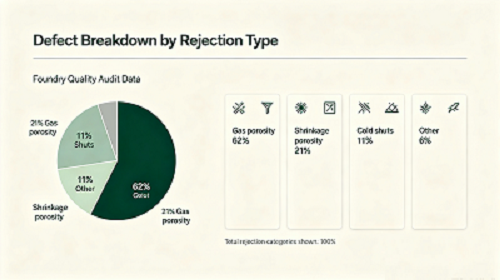
The plant manager showed me the rejection analysis:
| Defect Type | Percentage of Rejections |
|---|---|
| Gas porosity | 62% |
| Shrinkage porosity | 21% |
| Cold shuts | 11% |
| Other | 6% |
Gas porosity was the main problem. That pointed to hydrogen in the melt. Shrinkage porosity pointed to feeding issues. Cold shuts pointed to temperature loss during transfer.
I told the plant manager: “Your die is probably fine. Your alloy is probably fine. Your furnace and metal treatment are the problem.”
Step 1: Diagnosing the Root Cause
I started with a full process audit.
Temperature measurement:
I measured metal temperature at four points:
- In the melting furnace: 745°C
- In the transfer ladle: 718°C
- In the holding furnace: 702°C
- At the shot sleeve: 678°C
The temperature dropped 67°C from furnace to shot sleeve. That is far too much. For a 3.5 mm wall, the metal must arrive at the shot sleeve at 680–700°C. At 678°C, it was borderline. Some shots were colder. That explained the cold shuts.
Hydrogen measurement:
I used a portable hydrogen analyser. The reading was 0.32 ml/100g Al. The recommended maximum for structural die casting is 0.15 ml/100g Al. The melt was saturated with hydrogen.
Degassing practice:
The foundry was using a manual degassing lance. The operator would insert the lance for 3–4 minutes, then move to the next ladle. There was no measurement. No control. No consistency.
Holding furnace temperature control:
The holding furnaces had simple on-off controllers. The temperature swung ±15°C. The thermocouple was in one corner. The metal near the door was 20°C cooler than the metal near the heating elements.
Transfer practice:
The ladle was unheated. It was coated with a thin layer of refractory, but the coating was worn. The metal lost heat quickly. The transfer distance was 8 metres. It took 45 seconds.
The root cause was clear: hydrogen pickup and temperature loss. The gas porosity came from hydrogen. The cold shuts came from temperature loss. The shrinkage porosity came from inconsistent feeding, which was made worse by low metal temperature.
Step 2: The Optimisation Plan
We developed a four-part plan:
Replace manual degassing with rotary degassing. A rotary degasser with argon purging would reduce hydrogen to below 0.15 ml/100g. We chose a unit from a Chinese supplier. Cost: $9,500.
Upgrade holding furnace temperature control. Replace the on-off controllers with PID controllers. Add a second thermocouple for better temperature representation. Cost: $3,200 per furnace.
Reduce transfer temperature loss. Use a heated ladle and shorten the transfer distance. We built a new ladle preheating station. Cost: $4,800.
Implement hydrogen measurement. Measure hydrogen before every pour. Adjust degassing time accordingly. Cost: $2,500 for the analyser.
Total investment: $23,200.
Step 3: Installation and Commissioning
We installed the rotary degasser between the melting furnace and the holding furnaces. The degasser runs in batch mode. Each batch is 500 kg. Degassing time is 8 minutes with argon flow at 15 litres per minute.
We upgraded the holding furnace controllers. We added a second thermocouple near the door. The controller now averages the two readings. Temperature stability improved from ±15°C to ±4°C.
We built a ladle preheating station. The ladle is heated to 400°C before each transfer. Transfer time was reduced from 45 seconds to 25 seconds by moving the holding furnaces closer to the die casting machines.
We trained the operators on hydrogen measurement. Before each pour, they take a sample. If hydrogen is above 0.15 ml/100g, they increase degassing time. If it is below, they reduce it.
Step 4: Results After One Month
| Metric | Before | After | Improvement |
|---|---|---|---|
| Hydrogen content | 0.32 ml/100g | 0.12 ml/100g | 62% reduction |
| Temperature at shot sleeve | 678°C | 695°C | 17°C higher |
| Temperature stability | ±15°C | ±4°C | 4x better |
| Gas porosity rejection | 7.4% | 1.1% | 85% reduction |
| Shrinkage porosity rejection | 2.5% | 0.8% | 68% reduction |
| Cold shuts rejection | 1.3% | 0.3% | 77% reduction |
| Total rejection rate | 12.0% | 2.3% | 81% reduction |
| Annual savings (estimated) | — | $214,000 | — |
| Payback period | — | 6.5 weeks | — |
The plant manager was shocked. He had been ready to buy a new die casting machine. He didn't need one. He needed to fix the furnace and metal treatment process.
What Made the Difference
Three things drove the improvement:
1. Hydrogen removal. The rotary degasser reduced hydrogen from 0.32 to 0.12 ml/100g. That eliminated the gas porosity. Gas porosity was 62% of all rejections. Fixing it alone cut the rejection rate almost in half.
2. Temperature control. The PID controllers and second thermocouple stabilised the holding furnace temperature. The heated ladle and shorter transfer reduced temperature loss. The metal arrived at the shot sleeve at 695°C instead of 678°C. That eliminated cold shuts and improved feeding.
3. Measurement and control. The hydrogen analyser allowed operators to adjust degassing time based on actual measurements. No more guessing. No more inconsistency.
I have written about how to reduce oxidation loss and how to choose a die casting furnace. But for porosity, the furnace and metal treatment are only part of the story. The transfer, the holding, and the measurement all matter.
What You Can Apply
If you are experiencing porosity in your die castings, ask yourself these questions:
What is your hydrogen content? If you do not measure it, you cannot control it.
What is your temperature at the shot sleeve? If it is below 680°C, you will have cold shuts.
What is your temperature stability in the holding furnace? If it swings more than ±5°C, you will have inconsistent quality.
How long is your transfer? If it takes more than 30 seconds, you are losing temperature.
Is your degassing consistent? If you do not measure, it is not consistent.
These are not theoretical. They are the minimum requirements for structural die casting. I have seen foundries in China, Thailand, and Mexico fail because they ignored one of these.
When to Call an Expert
You can measure these things yourself. A pyrometer, a hydrogen analyser, and a stopwatch will tell you most of what you need to know. But sometimes an experienced eye sees the system, not just the components.
The Guangdong foundry had a competent maintenance team. They had kept the furnaces running for years. But they had never integrated hydrogen measurement with degassing control. They did not know what they did not know.
My fee for the five-day audit and commissioning support was $8,500. The annual saving was $214,000. That is a 25x return.
If you are experiencing porosity problems, and your rejection rate is above 5%, call someone. Or use the checklists on this blog. Either way, do not wait.
Final Thoughts
Reducing die casting porosity is not about buying a new die casting machine. It is about controlling the melt. Hydrogen, temperature, and transfer time.
In my 25 years, I have seen this pattern repeat in foundries across the world. The biggest gains come from fixing the furnace and metal treatment process, not from changing the die.
If you run a die casting plant, start by measuring your hydrogen content and temperature at the shot sleeve. If either is out of specification, fix it. You will see the difference in your rejection rate.
Internal links: How to Choose the Right Aluminium Melting Furnace, How Die Casting Furnace Technology Is Evolving for Electric Vehicle Manufacturing, Case Study – How a Chinese Expert Optimized Die Casting Furnace for EV Part Production
About the Author: Hu Shenyue is a veteran aluminium melting furnace expert with 25 years of hands-on experience in China, Southeast Asia, India, the UK, and Europe. He writes practical, experience-based content on furnace selection, maintenance, and optimisation at SmeltPro.