

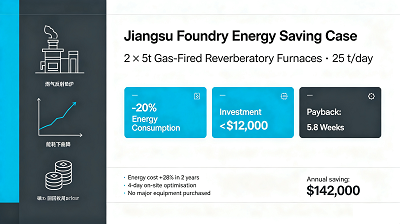
In early 2023, a mid-sized foundry in Jiangsu Province contacted me. They run two gas-fired reverberatory furnaces, each with a 5-tonne capacity. They melt around 25 tonnes per day of ADC12 and A380 for automotive and industrial castings. Their energy bill had risen 28% in two years. The plant manager told me, “We cannot pass these costs to our customers. We need to cut energy, but we cannot afford new furnaces.”
I spent four days on site. We made no major equipment purchases. By the end of the following month, their energy consumption per tonne had dropped by 20%. The total investment was less than $12,000. The payback period was just under six weeks.
This is how we did it.
The Starting Point: Energy Consumption at 980 kWh/t
When I arrived, the furnaces were consuming an average of 980 kWh per tonne of aluminium melted. That is typical for a legacy gas-fired reverb furnace, but well above the modern benchmark of 550–650 kWh/t.
I measured three things first:
Flue gas temperature: 870°C after the recuperator. The recuperator was partially blocked.
Oxygen in flue gas: 7.2%. Too much excess air.
Furnace shell temperature: Hot spots at 160–190°C in several areas. The lining was losing heat.
The plant manager admitted they had no formal maintenance schedule. The burners had not been tuned in over two years. The recuperator had never been cleaned. The door seals were original — 8 years old.
I told him: “Your furnaces are not broken. They are neglected. We can fix this without buying new equipment.”
Step 1: Burner Tuning — The Biggest Single Win
The burners were running with 7.2% oxygen. The ideal range is 2–4%. Too much excess air means you are heating nitrogen instead of aluminium. Every 1% reduction in O₂ saves roughly 2–3% of fuel.
We borrowed a portable flue gas analyser and spent a full day tuning both burners. We:
Cleaned the burner nozzles (they were partially clogged with carbon)
Adjusted the air dampers
Re-set the gas pressure regulators
Checked the flame shape and colour
The result: O₂ dropped to 3.3%. CO stayed below 25 ppm. Flame colour changed from yellow to a crisp blue.
That single change reduced gas consumption by 11%. No new parts. Just proper adjustment.
I have written a detailed guide on how to optimise burner efficiency. The principles are simple: measure, adjust, verify.
Step 2: Recover Waste Heat — The Second Big Win
The flue gas was leaving the recuperator at 870°C. That is money going up the stack.
We inspected the recuperator. It was partially blocked with soot and dust. The foundry had never cleaned it. We removed the access panels and cleaned the tubes with a brush and compressed air.
We also found a leaking gasket on the recuperator inlet. We replaced it for $80.
After cleaning, the combustion air preheat temperature rose from 180°C to 340°C. Every 100°C of preheat improves efficiency by about 5%. That gave us another 6% energy saving.
The total cost for this step: $80 for the gasket, plus two days of maintenance labour.
I have written about heat recovery in my guide on burner efficiency. It is often overlooked. Do not overlook it.
Step 3: Fix Door Seals and Lining Hot Spots
The furnaces had two main heat leaks:
Door seals: Worn flat. We could feel hot air escaping. Replacing them cost $350 per furnace.
Refractory hot spots: The shell was 170°C in two areas. We applied a refractory coating to the affected zones. Cost: $900 total.
These fixes reduced heat loss by another 2%. They also made the working environment safer.
A thermal camera is invaluable for this. If you do not have one, borrow one. The hot spots you find will pay for the effort.
Step 4: Change Operating Practice — Free Savings
The operators were making three mistakes:
Charging wet scrap. They stored scrap outdoors. After rain, they charged it wet. Moisture absorbs heat and increases oxidation.
Overcharging. They filled the furnace to 95% capacity. The burner could not melt efficiently.
Holding metal overnight at 750°C. They melted on Friday and held until Monday.
We changed these practices:
Built a simple drying rack under a roof. Scrap dries before charging.
Reduced charge to 80% of capacity. Melt time dropped, and oxidation loss fell.
Adjusted the schedule: melt on Sunday evening for Monday start. Holding temperature reduced to 700°C.
These changes cost nothing. They saved another 1% in energy and reduced metal loss by 0.6%.
I have written about reducing oxidation loss. It is often the hidden cost that nobody measures.
Step 5: Install Simple Monitoring
We installed a gas flow meter and a temperature logger on each furnace. The cost was $550 per furnace.
Now the plant manager can see daily gas consumption per tonne. If it rises, he knows something is wrong. He can call me before the problem gets worse.
Data is not a luxury. It is the foundation of control.
The Results After One Month
| Metric | Before | After | Improvement |
|---|---|---|---|
| Energy consumption | 980 kWh/t | 784 kWh/t | 20% reduction |
| Flue gas O₂ | 7.2% | 3.3% | Optimised |
| Metal oxidation loss | 2.9% | 2.3% | 0.6% reduction |
| Annual energy cost (25 t/day) | $710,000 | $568,000 | $142,000 saved |
| Investment | — | $11,800 | Payback: 5.8 weeks |
The plant manager was shocked. He had been told he needed new furnaces. He didn’t. He needed someone to look at the details.
What I Learned — And What You Can Apply
This case is not unique. I have seen similar results in Vietnam, India, Thailand, the UK, and the US. The pattern is always the same:
Most furnaces are running with too much excess air. Tune the burner first. It is the cheapest and biggest win.
Waste heat is free money. Clean the recuperator. It pays for itself in weeks.
Small leaks add up. Door seals, lining cracks, and open doors waste more than you think.
Operating habits matter. Wet scrap, overcharging, and unnecessary holding are common and costly.
Measure everything. You cannot improve what you do not measure.
I wrote a detailed guide on how to optimise burner efficiency and a furnace maintenance checklist. If you follow those, you will capture most of these savings yourself.
When to Call an Expert
You can do much of this work yourself. But sometimes an experienced eye finds things you miss. The plant in Jiangsu had a maintenance team. They were competent. But they had never been trained on combustion analysis or thermal imaging.
I spent four days on site. The fee was less than 8% of the annual savings. That is a good return.
If your energy bills are rising, and you have not tuned your burners in the last six months, call someone. Or buy a flue gas analyser and learn to do it yourself. Either way, do not wait.
Final Thoughts
Cutting energy costs by 20% did not require new furnaces. It required attention to detail, a few inexpensive parts, and a willingness to change habits.
In my 25 years, I have seen this pattern repeat in foundries across the world. The biggest savings are often hiding in plain sight — in the burner, in the flue, in the door seal, in the charging practice.
If you run a foundry, start with the burner. Then clean the recuperator. Then fix the leaks. Then train the operators. You will see the difference in your first gas bill.
Internal links: How to Optimize Burner Efficiency in Gas-Fired Aluminium Furnaces, Furnace Maintenance Checklist, How to Reduce Oxidation Loss in Aluminium Melting Operations
About the Author: Hu Shenyue is a veteran aluminium melting furnace expert with 25 years of hands-on experience in China, Southeast Asia, India, the UK, and Europe. He writes practical, experience-based content on furnace selection, maintenance, and optimisation at SmeltPro.