

Practical guide to choosing the right crucible for your aluminium melting furnace. Based on 25 years of foundry experience. Avoid costly downtime.
Choosing the right crucible comes down to four things: alloy and melting temperature, furnace type and capacity, crucible material, and supplier quality. Get one wrong, and you’ll pay for it in downtime, poor metal quality, or a cracked crucible at 2 a.m.
I’ve seen it all in 25 years. Here’s what actually matters.
Start with Alloy and Temperature
Not all aluminium alloys melt the same way. Pure aluminium melts at around 660°C. But in a foundry, you’re usually running hotter — 700°C to 750°C for many die casting alloys. Some aerospace alloys go higher.
The crucible must handle your maximum temperature with a safety margin. If you run at 750°C, don’t buy a crucible rated to 800°C and expect it to last. It won’t.
| Crucible Material | Max Temperature | Thermal Shock Resistance | Typical Use |
|---|---|---|---|
| Clay-graphite | 1200°C | Moderate | Small jobbing foundries |
| Silicon carbide | 1400°C | Excellent | Most aluminium foundries |
| Graphite | 1300°C | Poor to moderate | High-purity melts, controlled atmosphere |
| Cast iron | 800°C | Good | Low-temperature aluminium, but iron pickup risk |
Match the Crucible to Your Furnace Type
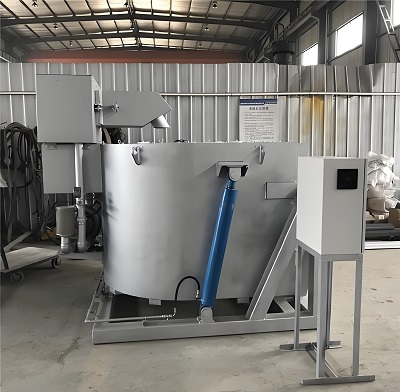
A crucible that works in a resistance furnace may fail in a gas-fired furnace. Why? Thermal cycling. Gas burners create hot spots. The crucible expands and contracts unevenly. If it can’t handle thermal shock, it cracks.
For gas-fired crucible furnaces, silicon carbide is usually the best choice. For electric resistance furnaces, you have more options. Clay-graphite works if cycles are gentle. Graphite works if you control oxidation.
Tilting furnaces need a crucible with the correct base and clamping system. I’ve seen operators force a crucible into a tilting furnace because it was the wrong shape. It cracked on the first tilt.
Capacity and Freeboard
Never fill a crucible above 80–85% of its capacity. You need freeboard — the empty space above the molten metal. It allows for expansion and reduces spill risk.
A 500 kg furnace does not mean a 500 kg crucible. Use a 400 kg crucible. The extra space keeps you safe and gives you better temperature control.
Cycle time matters too. A larger crucible takes longer to melt if your burner is undersized. I’ve seen foundries buy a bigger crucible to increase output, then wonder why melting time doubled.
Material Selection in Detail
Clay-graphite is the cheapest option. It works for small foundries with low production. But life is short. If you run three shifts a day, you’ll replace it often.
Silicon carbide is the workhorse. It handles thermal shock, lasts longer, and resists oxidation. Yes, it costs more up front. But the cost per hour of service is usually lower.
Graphite has excellent thermal conductivity. It melts fast. But it oxidises above 600°C in air. You need a protective atmosphere or a coating. In a normal foundry, it’s a bad choice unless you have a specific reason.
Cast iron is only for low-temperature aluminium. It’s cheap and tough. But iron can dissolve into the melt and ruin your alloy chemistry. I avoid it for structural castings.
A Real Case from Vietnam
In 2022, I visited a die casting plant in Vietnam. They were using graphite crucibles in a gas-fired furnace. Every six weeks, a crucible failed. Production stopped. They lost eight hours each time.
We switched them to silicon carbide crucibles with the correct base. The first crucible lasted five months. Downtime dropped from eight hours a month to almost zero. The cost per tonne of aluminium melted fell by 18%.
That’s the difference between choosing on price and choosing on performance.
The Hidden Costs of Cheap Crucibles
A cheap crucible is not cheap. When it fails, you lose metal, time, and safety. A cracked crucible can leak molten aluminium. That’s a serious hazard.
I always tell foundry managers: look at cost per hour of service, not purchase price. A crucible that costs £200 and lasts 200 hours costs £1 per hour. A crucible that costs £500 and lasts 1,000 hours costs £0.50 per hour. The expensive one is actually cheaper.
How to Evaluate a Supplier
Ask these questions before you buy:
- What is the density and porosity of the crucible?
- What is the thermal shock resistance rating?
- What is the maximum working temperature?
- Do you have references in my region?
- What is the lead time for replacement?
- Do you offer technical support?
A supplier who can’t answer these questions is not a partner. They’re just a seller.
A Simple Checklist Before You Buy
- What alloy will you melt, and at what maximum temperature?
- What furnace type and capacity do you have?
- How many heating cycles per day?
- What freeboard do you need?
- What is the cost per hour of service?
- Does the supplier offer local support?
- Are spare crucibles available quickly?
Final Thoughts
The right crucible is not the cheapest or the most expensive. It’s the one that matches your process. In my experience, silicon carbide is the safe choice for most aluminium foundries. But if you run a small jobbing shop with low cycles, clay-graphite may be fine.
Don’t guess. Measure your temperatures. Check your cycle times. Ask suppliers the hard questions. And remember: a crucible is not a consumable you buy once a year. It’s a critical part of your melting system. Treat it that way.
About the Author: Hu Shenyue is a veteran aluminium melting furnace expert with 25 years of hands-on experience in China, Southeast Asia, India, the UK, and Europe. He writes practical, experience-based content on furnace selection, maintenance, and optimisation at SmeltPro.
Internal links: How to Choose the Right Aluminium Melting Furnace, Furnace Maintenance Checklist.
About the Author: Hu Shenyue is a veteran aluminium melting furnace expert with 25 years of hands-on experience in China, Southeast Asia, India, the UK, and Europe. He writes practical, experience-based content on furnace selection, maintenance, and optimisation at SmeltPro.