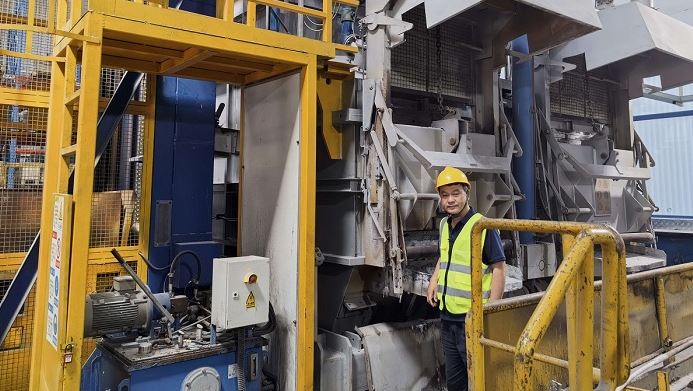
Consistent melt temperature in a holding furnace comes down to three things: correct thermocouple placement, proper heating zone control, and stable metal level. Get these right, and your die casting machine receives the same metal temperature shot after shot. Get them wrong, and you fight cold shuts, porosity, and scrap forever.
I have spent 25 years setting up and troubleshooting aluminium holding furnaces for die casting. The temperature swings I see are rarely caused by a failed heating element. They are caused by measurement errors, poor circulation, and operator habits. Here is how I fix them.
Why Temperature Consistency Matters
A die casting holding furnace that swings ±15°C will produce inconsistent castings. A furnace that holds ±3°C will produce consistent castings. The difference is not the die. It is the furnace control.
When the temperature is too high, hydrogen absorption increases, oxidation accelerates, and the die overheats. When the temperature is too low, fluidity drops and cold shuts appear. For ADC12, the recommended holding temperature is 660–680°C. For A380, it is 680–700°C.
I have written about how to optimise die casting furnace temperature for A380 and ADC12 alloys. The holding furnace is where that temperature is maintained.
Cause 1: Thermocouple Placement
This is the most common cause of temperature inconsistency I see. The thermocouple is in the wrong place, or there is only one.
In one foundry in Thailand, the holding furnace had a single thermocouple in one corner. The metal near the door was 25°C cooler than the metal near the heating elements. The controller was maintaining the corner temperature. The metal at the shot sleeve was too cold. Cold shuts appeared on every shift.
We added a second thermocouple near the door. The controller now averages the two readings. Temperature stability improved from ±18°C to ±4°C. The scrap rate dropped by half.
The fix: Use two thermocouples — one near the heating elements, one near the door or discharge point. Average the readings. Verify with a handheld pyrometer at the shot sleeve.
Cause 2: Heating Zone Imbalance
Many holding furnaces have multiple heating zones. If one zone runs hotter than another, the metal temperature is uneven. The thermocouple reads one zone. The metal from another zone is different.
I use a thermal camera to map the bath temperature. If I see more than 10°C variation, I adjust the zone power settings. For critical parts, I target ±5°C across the bath.
A foundry in Guangdong had a three-zone holding furnace. The centre zone was running 20°C hotter than the side zones. We rebalanced the power settings and added a circulation baffle. Temperature uniformity improved to ±3°C. Porosity defects dropped by 60%.
The fix: Map the bath with a thermal camera or multiple thermocouples. Rebalance zone power. Add baffles or circulation to improve mixing.
Cause 3: Low Metal Level
If the metal level drops too low, the thermocouple may not be immersed properly. The controller reads the air temperature instead of the metal temperature. It cycles the heat on and off. The metal temperature fluctuates.
For ADC12 holding furnaces, the thermocouple should be at least 50 mm below the metal surface. If the level drops below that, the reading is wrong.
A foundry in Vietnam had a furnace that would not hold temperature after lunch. The operator was not adding metal. The level dropped. The thermocouple was exposed. We set a minimum level alarm. The problem stopped.
The fix: Maintain the correct metal level. Add ingot or scrap as needed. Set a minimum level alarm. For automatic furnaces, check the level sensor.
Cause 4: Controller Settings
The controller uses PID settings to manage temperature. If the settings are wrong, the furnace overshoots and undershoots. It never holds steady.
I have seen controllers left at factory defaults for furnaces twice the size. The result is wild cycling. The metal temperature swings ±20°C.
The fix is to re-tune the PID. Use the auto-tune function if available. If not, adjust manually: increase proportional band if overshooting, decrease if slow.
The fix: Verify PID settings match the furnace volume and heat transfer characteristics. Re-tune after any controller change or furnace modification.
Cause 5: Door Seal and Insulation
A worn door seal lets heat escape. The furnace loses temperature faster than it can recover. The heating elements run constantly. The temperature still fluctuates.
I check door seals weekly. If I feel hot air escaping, the seal is leaking. A €200 replacement can restore temperature stability immediately.
The fix: Inspect door seals weekly. Replace when worn. Check furnace insulation for hot spots. Repair or replace damaged refractory.
A Real Case from Southeast Asia
In 2024, a die casting plant in Rayong, Thailand, was running both A380 and ADC12 on the same holding furnace. They changed alloys twice per week. Their rejection rate was 8% overall.
I watched them switch from ADC12 to A380 without changing the setpoint. The furnace stayed at 670°C. That was fine for ADC12. For A380, it was 15–20°C too cold.
We set up two recipes on the furnace controller: one for A380 at 690°C, one for ADC12 at 665°C. The operator selects the recipe when changing alloys. We also added a second thermocouple near the door.
The rejection rate dropped to 3.4% within two weeks. The energy consumption dropped by 4% because they were no longer running A380 too hot or ADC12 too cold.
A Simple Checklist for Consistent Holding Furnace Temperature
-
Use two thermocouples — one near heating elements, one near discharge.
-
Verify with a handheld pyrometer at the shot sleeve.
-
Map bath temperature with a thermal camera. Target ±5°C uniformity.
-
Maintain correct metal level. Keep thermocouple immersed.
-
Verify PID settings match furnace size and characteristics.
-
Check door seals weekly. Replace when worn.
-
Rebalance heating zone power if non-uniform.
-
Set alloy-specific recipes on the controller.
-
Train operators to record temperature every shift.
-
Investigate any drift immediately.
Final Thoughts
Consistent melt temperature is not about buying a better furnace. It is about measuring correctly, controlling properly, and maintaining discipline.
In my 25 years, I have seen foundries transform their quality by fixing the holding furnace. The furnace did not change. The measurement and control did.
If your die casting quality varies, start with the holding furnace thermocouple. Then check the metal level. Then verify the PID. You will find the cause.
About the Author: Hu Shenyue is a veteran aluminium melting furnace expert with 25 years of hands-on experience in China, Southeast Asia, India, the UK, Europe, and North America. He writes practical, experience-based content on furnace selection, maintenance, and optimisation at SmeltPro.
Internal links: How to Optimize Die Casting Furnace Temperature for A380 and ADC12 Alloys, Why Is My Die Casting Furnace Not Maintaining Setpoint Temperature, How to Fix a Furnace That Is Not Reaching Setpoint Temperature