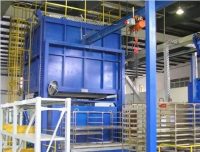
Contaminated scrap is the hardest material to melt profitably. It is dirty, mixed, coated, and often wet. A single-chamber reverb furnace will choke on it — losing metal to oxidation, generating excessive dross, and struggling to maintain temperature. A rotary furnace can handle it, but consumes salt at a rate that eats into margins.
The twin-chamber furnace is the middle path. It separates the melting of dirty scrap from the holding of clean metal. It uses less salt than a rotary furnace. It recovers more metal than a reverb furnace. For the right application, it is the best available technology.
I have spent 25 years working with aluminium recycling furnaces in China, Southeast Asia, India, Europe, and North America. I have helped more than a dozen plants select and commission twin-chamber furnaces. The pattern is always the same: the furnace works if the feedstock is right and the operator understands the system.
This article tells you what to look for when choosing a twin-chamber furnace for contaminated scrap processing.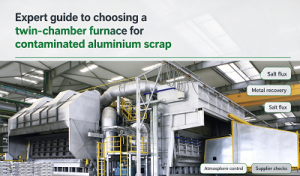
What Makes Contaminated Scrap Difficult
Before you choose a furnace, understand what you are feeding it.
| Contaminant | Source | Effect on Melting |
|---|---|---|
| Oil and grease | Machining chips, turnings | Smoke, flame, hydrogen pickup, dross |
| Paint and coatings | Painted extrusions, UBC | Organic combustion, dross, emissions |
| Moisture | Outdoor storage, wet scrap | Steam explosions, thermal shock, hydrogen |
| Iron and steel | Mixed scrap, fasteners | Alloy contamination, hard spots |
| Plastics and rubber | Wire, cable, composite | Dioxin risk, dross, emissions |
| Salt and dirt | Post-consumer scrap | Refractory attack, dross |
The twin-chamber furnace is designed for the first four. It struggles with plastics and rubber unless the emissions system is designed for it.
How a Twin-Chamber Furnace Works
A twin-chamber furnace has two distinct zones separated by a baffle:
| Zone | Function | Atmosphere | Temperature |
|---|---|---|---|
| Melting chamber | Melts contaminated scrap, separates metal from oxide | Reducing, low oxygen | 750–850°C |
| Holding chamber | Holds clean metal, adjusts chemistry | Inert, controlled | 680–720°C |
Contaminated scrap goes into the melting chamber. Salt flux is added. The metal melts and flows under the baffle into the holding chamber. The oxide floats as slag and is removed. The clean metal in the holding chamber is not exposed to the contaminants.
That separation is the key. It allows you to process dirty scrap without contaminating the clean metal.
Specification 1: Chamber Sizing
The most common mistake I see is an undersized holding chamber. The melting chamber gets all the attention. The holding chamber is treated as an afterthought.
The holding chamber should be sized to hold 30–40% of the melting chamber capacity. For a 5-tonne furnace, the holding chamber should be 1.5–2 tonnes. That gives the operator time to adjust chemistry and temperature before tapping.
At a plant in Malaysia, the holding chamber was only 800 kg. That was too small. The metal was tapped before it was properly alloyed. Quality varied. We increased the holding chamber volume by raising the bath level. The problem was solved.
What to look for:
| Feature | Specification | Why It Matters |
|---|---|---|
| Melting chamber capacity | Matched to production rate | Determines throughput |
| Holding chamber capacity | 30–40% of melting chamber | Allows chemistry adjustment |
| Baffle height | Forces metal under, not over | Keeps slag in melting chamber |
| Bath depth | Sufficient for submerged charging | Reduces oxidation |
Specification 2: Atmosphere Control
The melting chamber should run with a reducing atmosphere. That means low oxygen, high CO. A reducing atmosphere protects the metal from oxidation and helps the salt flux work.
What to look for:
| Feature | Specification | Why It Matters |
|---|---|---|
| Burner control | Sub-stoichiometric combustion | Creates reducing atmosphere |
| Sealed chamber | Gas-tight doors and ports | Prevents air infiltration |
| Oxygen monitoring | Continuous O₂ measurement | Proves atmosphere control |
| Pressure control | Slight positive pressure | Keeps air out |
| Exhaust control | Controlled, not open | Reduces heat loss |
At the Malaysian plant, the melting chamber was running at 4% oxygen. That is too high. We reduced it to 1.5% by adjusting the burner and sealing the door. Oxidation loss dropped immediately.
I have written about how to set up twin-chamber melting furnace for high-volume aluminium recycling. The principles apply here.
Specification 3: Salt Flux System
Salt flux is essential for contaminated scrap. It protects the metal from oxidation and helps coalesce fine droplets. But too much salt increases slag volume and cost. Too little salt reduces recovery.
The salt factor — the ratio of salt to scrap — depends on the scrap quality:
| Scrap Type | Recommended Salt Factor |
|---|---|
| Clean extrusion offcuts | 0.2–0.3 |
| UBC and painted scrap | 0.4–0.6 |
| Turnings and chips | 0.6–0.8 |
| Dross and heavily contaminated | 0.8–1.2 |
What to look for:
| Feature | Specification | Why It Matters |
|---|---|---|
| Salt addition system | Automated or manual | Consistent addition |
| Salt composition | NaCl-KCl-cryolite | Cryolite improves oxide removal |
| Salt factor target | 0.4–0.8 for mixed scrap | Balances recovery and cost |
| Slag removal | Skimming door or slag tap | Efficient removal |
| Dross press compatibility | Space and connections | Recovers metal from slag |
A foundry in Guangdong that changed their flux composition from 5% cryolite to 25% cryolite improved metal recovery by 3 percentage points. Salt consumption dropped by 40%.
Specification 4: Metal Transfer and Baffle Design
The baffle separates the melting chamber from the holding chamber. It controls how metal flows from one to the other. A poorly designed baffle causes short-circuiting — metal flows directly from the charge to the holding chamber without proper residence time.
What to look for:
| Feature | Specification | Why It Matters |
|---|---|---|
| Baffle position | Forces metal under, not over | Keeps slag in melting chamber |
| Baffle height | Adjustable or optimised | Matches bath level |
| Transfer port | Submerged, not surface | Prevents slag carryover |
| Metal circulation | Natural or pumped | Ensures uniform temperature |
At the Malaysian plant, the baffle was too high. Slag was flowing over the top. The holding chamber was contaminated. We lowered the baffle by 150 mm. The problem was solved.
Specification 5: Refractory Selection
The refractory lining must withstand chemical attack from salt flux, thermal cycling, and metal penetration. A poor refractory choice leads to early failure and costly downtime.
What to look for:
| Feature | Specification | Why It Matters |
|---|---|---|
| Non-wetting refractory | High-purity alumina or equivalent | Prevents metal penetration |
| Salt resistance | Specified by supplier | Withstands flux attack |
| Thermal shock resistance | Good to excellent | Handles cycling |
| Installation quality | Certified installer | Prevents premature failure |
| Expected life | 3–5 years minimum | Reduces lifecycle cost |
I have written about how to diagnose and repair furnace refractory cracking. Refractory condition affects metal recovery.
Specification 6: Control System and Data Logging
A modern twin-chamber furnace must have PLC-based control with data logging. The data is needed for traceability and process optimisation.
What to look for:
| Feature | Specification | Why It Matters |
|---|---|---|
| PLC control | Siemens, Allen-Bradley, or equivalent | Reliable, spare parts available |
| Temperature control | PID, multiple thermocouples | Stable melting and holding |
| Data logging | Charge weight, temperature, energy | Traceability |
| OPC UA connectivity | For MES integration | Data transfer |
| Recipe management | Scrap-specific settings | Quick changeover |
A Real Case from Malaysia
In 2023, a recycling plant in Johor was processing mixed contaminated scrap — UBC, turnings, and painted extrusions. They were using a rotary furnace. Salt consumption was high. Metal recovery was 84%.
We evaluated a twin-chamber furnace from a Chinese supplier. The specifications:
| Parameter | Specification |
|---|---|
| Melting chamber | 5 tonnes |
| Holding chamber | 1.8 tonnes |
| Burner | Regenerative, sub-stoichiometric |
| Salt factor | 0.5–0.7 |
| Metal recovery guarantee | 91% |
| Energy consumption guarantee | 680 kWh/t |
The plant manager visited a reference site in China. The furnace was processing similar scrap. Recovery was 91%. Salt consumption was 40% lower than their rotary furnace.
They chose the twin-chamber furnace. Results after three months:
| Metric | Before (Rotary) | After (Twin-Chamber) | Improvement |
|---|---|---|---|
| Metal recovery | 84% | 91% | 7% improvement |
| Salt consumption | High | 40% lower | Cost reduction |
| Energy consumption | 890 kWh/t | 663 kWh/t | 25% reduction |
| Annual savings | — | $1,460,000 | — |
| Investment | — | $420,000 | Payback: 3.5 months |
The plant manager told me: “We should have switched years ago.”
A Simple Selection Checklist
- Define your feedstock: UBC, turnings, painted scrap, mixed.
- Size the holding chamber at 30–40% of melting chamber.
- Specify reducing atmosphere for melting chamber. Target 1.5% O₂.
- Specify salt factor for your scrap type. 0.4–0.8 for mixed.
- Specify flux composition. 20–25% cryolite for better oxide removal.
- Verify baffle design. Forces metal under, not over.
- Specify non-wetting, salt-resistant refractory.
- Require PLC data logging with OPC UA connectivity.
- Visit a reference site processing similar scrap.
- Get the metal recovery and energy consumption guarantees in writing.
When to Call an Expert
You can evaluate a twin-chamber furnace yourself. But sometimes an experienced eye sees what you miss. The Malaysian plant had a competent team. They had run rotary furnaces for years. But they had never optimised a twin-chamber design.
My fee for the five-day audit and selection support was $14,000. The annual saving was $1.46 million. That is a 104x return.
If you are processing contaminated scrap and your recovery is below 88%, call someone. Or use the checklists on this blog. Either way, do not wait.
Final Thoughts
Choosing a twin-chamber furnace for contaminated scrap processing is not about buying the biggest furnace. It is about matching the furnace to your feedstock and operating it properly. Chamber sizing, atmosphere control, salt flux management, baffle design, and refractory selection all matter.
In my 25 years, I have seen plants recover millions by switching from rotary to twin-chamber furnaces. The scrap did not change. The furnace did.
If you run a recycling plant, start by measuring your metal recovery and salt consumption. If either is out of specification, consider a twin-chamber furnace. You will see the difference in your profit.
About the Author: Hu Shenyue is a veteran aluminium melting furnace expert with 25 years of hands-on experience in China, Southeast Asia, India, the UK, Europe, and North America. He writes practical, experience-based content on furnace selection, maintenance, and optimisation at SmeltPro.
Internal links: How to Set Up Twin-Chamber Melting Furnace for High-Volume Aluminium Recycling, How to Choose a Secondary Aluminium Melting Furnace for Ingot Production, How to Improve Metal Recovery in Aluminium Scrap Melting, How to Reduce Metal Loss in Secondary Aluminium Melting for Ingot Production, How to Evaluate the Reliability of Chinese Aluminium Furnace Manufacturers.