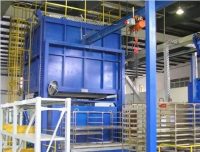
Most side-well furnace articles tell you the same thing: high efficiency, low burn loss, excellent for thin scrap. That is true. But they leave out the part that actually matters when you are standing in front of a purchase order with a supplier who promises 3 tonnes per hour and a plant manager who needs it to work.
I have spent 25 years commissioning and troubleshooting aluminium melting furnaces. In 2023, I helped a recycling plant in Zhejiang select and commission an 8-tonne side-well furnace with a mechanical pump system. The specification said 1.5 tonnes per hour. After tuning, they achieved 1.8 tonnes per hour sustained. That is the reality of melting rates.
This article is not a repeat of the brochure. It is what I tell clients who are considering a 3-ton side-well furnace for scrap recycling.
What “3-Ton/Hour” Actually Means
A furnace rated at 3 tonnes per hour does not melt 3 tonnes every hour. It melts 3 tonnes under specific conditions:
-
Consistent, prepared feedstock
-
Continuous operation
-
Adequate molten metal circulation
-
No unplanned downtime
In practice, a 3-ton side-well furnace processing mixed scrap typically delivers 2.2 to 2.8 tonnes per hour. The gap comes from three things:
| Factor | Impact on Output |
|---|---|
| Feedstock density and moisture | 10–25% reduction if scrap is wet or inconsistent |
| Circulation pump performance | 5–15% reduction if metal flow is inadequate |
| Operational interruptions | 5–10% reduction from cleaning and maintenance |
When a supplier quotes 3 tonnes per hour, ask them: “Under what feedstock conditions?” If they cannot specify, the number is marketing.
The Circulation System Is Everything
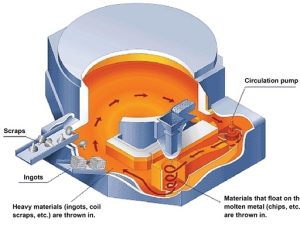
A side-well furnace is not just a reverb furnace with a well bolted to the side. It is a circulation system. The well creates a flow pattern that pulls light scrap below the surface, melts it in the existing bath, and returns the cooled metal to the main hearth for reheating.
Without proper circulation, the well stagnates. Heat transfer drops. Melting stops.
There are two main types of circulation systems:
| System | How It Works | Advantages | Disadvantages |
|---|---|---|---|
| Mechanical pump | Impeller draws metal from hearth, pushes through well | Reliable, proven, easier to maintain | Impeller wear, shaft maintenance |
| Electromagnetic pump | Linear motor moves metal through channels | No moving parts in melt, no shaft | Expensive, bulky, complex |
For a 3-ton side-well furnace, the mechanical pump is the practical choice. The impeller is typically a graphite or ceramic rotor positioned in the well. It rotates at 300–600 rpm, creating the flow that circulates metal through the system.
I have seen plants try to save money by omitting the pump. The result is always the same: the well stagnates, light scrap floats, and recovery drops below 85%.
Specification 1: Well Design and Channel Geometry
The well is not just a box. It is a carefully designed chamber with specific geometry. The channels connecting the well to the hearth must be positioned correctly.
According to patent literature, the metal inlet should be positioned above the bath level, and the outlet should be near the floor, allowing metal to flow back to the hearth. The channels should be short to prevent metal freezing during startup. For batch operations, the channels should be less than 1.2 metres in length.
A study on side-well furnace modelling confirms that the melt temperature decreases in the charging well and increases in the bath. The desired average metal temperature at the inlet to the pump weir is 730°C to 760°C.
| Feature | Specification | Why It Matters |
|---|---|---|
| Channel length | Under 1.2 m for batch operations | Prevents metal freezing |
| Channel angle | Inlet and outlet separated by 22.5° | Prevents short-circuiting |
| Impeller well diameter | Matched to impeller size | Creates proper vortex |
| Well depth | Sufficient for impeller immersion | Ensures pumping action |
Specification 2: Feedstock Compatibility
Side-well furnaces are designed for specific scrap types. They excel at thin, light gauge material that would float and oxidise in a conventional reverb furnace.
The twin-chamber side-well furnace is specifically designed for aluminium fluff, soda cans, radiator aluminium, and thin aluminium materials. It processes 3–10 tons per hour of these materials
.
| Feedstock Type | Suitability | Charging Method |
|---|---|---|
| UBC, foil, thin sheet | Excellent | Vortex well, continuous feed |
| Shredded scrap | Excellent | Vortex well, conveyor feed |
| Turnings, chips | Good | Vortex well, submerged feed |
| Extrusion offcuts | Good | Door charging or well |
| Heavy castings, sows | Moderate | Door charging only |
| Dross, heavily contaminated | Poor | Not recommended |
If your feedstock is heavy, clean, and sorted, a side-well furnace is overkill. A reverb or tower furnace will be more energy-efficient and easier to maintain. But if you process thin, light gauge scrap, the side-well design is the right choice.
Specification 3: Metal Recovery Rate
Metal recovery is the percentage of aluminium in the charge that ends up as saleable product. It is the single most important economic metric for a recycling plant.
The twin-chamber side-well furnace achieves metal recovery rates 2–3% higher than conventional furnace designs. Published data shows:
-
Metal recovery for thin scrap: 92–95% (compared to 89–92% for conventional reverb)
-
Metal loss: 2–3% depending on feedstock
A Chinese project specification for a side-well furnace processing aluminium chips lists a burn loss rate of ≤2% and a comprehensive melting rate of ≥1.5 tonnes per hour for an 8-tonne furnace.
| Parameter | Typical Value | Best Achievable |
|---|---|---|
| Metal recovery | 92–95% | 96%+ |
| Burn loss rate | 2–3% | ≤2% |
| Energy consumption | 55–75 Nm³/t | 55 Nm³/t |
Specification 4: Energy Consumption
Energy is the largest operating cost in aluminium recycling. The side-well furnace with regenerative combustion achieves exhaust temperatures below 250°C and energy savings of 20–30% compared to traditional furnaces.
A project specification for an 8-tonne side-well furnace lists a unit energy consumption of ≤55 Nm³ per tonne of aluminium. That is the benchmark for a well-designed, well-operated furnace.
| Furnace Type | Typical Energy Consumption |
|---|---|
| Side-well with regenerative burners | 55–75 Nm³/t |
| Side-well with recuperative burners | 70–90 Nm³/t |
| Conventional reverb | 100+ Nm³/t |
A Real Case from Zhejiang
In 2023, a recycling plant in Zhejiang commissioned a domestically produced 8-tonne side-well furnace for processing 6063 extrusion scrap and machining chips.
The specification:
-
Furnace capacity: 8 tonnes
-
Circulation: Mechanical pump + vortex well
-
Burner: Regenerative combustion
-
Target melting rate: 1.5 tonnes/hour
-
Target burn loss: ≤2%
The results:
-
After commissioning and tuning, the furnace achieved 1.8 tonnes/hour sustained
-
Metal loss was 1.8–2.2% on clean, sorted chips
-
Energy consumption was 55–60 Nm³/t
-
Compared to their previous reverb furnace, they recovered an additional 700 tonnes of aluminium per year on 10,000 tonnes of throughput
The challenges:
-
The first month was difficult. Wet scrap caused repeated system alarms.
-
Oily chips coked the preheating zone.
-
Oversized pieces bridged the feed chute.
The solution:
-
Installed a shredder, dryer, and magnetic separator
-
Implemented stricter incoming scrap inspection
-
Once feedstock was controlled, the furnace performed as designed
The plant manager told me: “The side-well furnace is not a machine. It is a system. If you buy the furnace but don’t invest in feedstock preparation, you will fail.”
A Simple Selection Checklist
-
Confirm feedstock quality. Thin, clean, dry, sized. If not, budget for preparation.
-
Specify circulation system. Mechanical pump is standard. Electromagnetic is expensive.
-
Verify well geometry. Channel length under 1.2 m. Inlet/outlet separated by 22.5°.
-
Ask for guaranteed melting rate for YOUR feedstock.
-
Ask for guaranteed metal recovery. Target 92%+ for thin scrap.
-
Specify burner type. Regenerative for maximum efficiency.
-
Check refractory life. Minimum 3–4 years for well area.
-
Visit a reference plant. Similar feedstock. At least 2 years in operation.
-
Ask about feedstock preparation. Does the supplier understand upstream?
-
Get the performance guarantee in writing.
When to Call an Expert
A side-well furnace is a complex system. The well, the pump, the burner, and the refractory must all work together. If one is wrong, the furnace underperforms.
The Zhejiang plant had a competent team. They had run reverb furnaces for years. But they had never operated a side-well furnace. They did not know what they did not know.
If you are considering a side-well furnace, bring in someone who has seen them operate. The cost of a consultant is small compared to the cost of a furnace that does not perform.
Final Thoughts
Selecting a side-well furnace with a 3-ton/hour melting rate is not about buying the biggest well. It is about matching the circulation system, well design, and burner to your feedstock.
In my 25 years, I have seen plants succeed with side-well furnaces and plants fail. The difference is always the same: circulation and feedstock preparation. If the metal moves and the scrap is right, the furnace works. If not, it does not.
If you run a recycling plant and your thin scrap recovery is below 90%, consider a side-well furnace. But understand what you are buying. The well is not a hole. It is a system.
About the Author: Hu Shenyue is a veteran aluminium melting furnace expert with 25 years of hands-on experience in China, Southeast Asia, India, the UK, Europe, and North America. He writes practical, experience-based content on furnace selection, maintenance, and optimisation at SmeltPro.
Internal links: How to Select a Side-Well Furnace for Aluminium Scrap Recycling, How to Improve Side-Well Furnace Scrap Submersion Efficiency, How to Improve Metal Recovery in Aluminium Scrap Melting, How to Choose a Secondary Aluminium Melting Furnace for Ingot Production, How to Evaluate the Reliability of Chinese Aluminium Furnace Manufacturers.