
Metal recovery in ingot casting is not just about the furnace. It is about everything that happens between the furnace tap and the stacked ingot. I have spent 25 years chasing recovery rates in secondary aluminium plants, and the pattern is always the same: the furnace gets the attention, but the casting line loses the metal.
In 2023, I worked with a recycling plant in Johor, Malaysia. They were melting 30 tonnes per day of mixed scrap in a 5-tonne tilting rotary furnace. Their overall metal recovery was 82%. They had invested in a new furnace and a new dross press. But the recovery rate had not improved. The plant manager was frustrated. He told me: “We have done everything on the furnace side. The problem must be the scrap.”
I spent six days on site. The problem was not the scrap. It was the casting line. By the end of the following month, metal recovery had improved to 91%. The annual saving was over $2.1 million.
This is how we did it.
Why Ingot Casting Loses Metal
Metal loss in ingot casting happens in five places:
| Loss Point | Typical Loss | Cause |
|---|---|---|
| Furnace tap | 0.5–1.5% | Oxidation during transfer |
| Holding furnace | 0.5–1.0% | Surface oxidation, skimming loss |
| Casting tundish | 0.3–0.8% | Temperature loss, cold shuts |
| Mould filling | 0.2–0.5% | Splash, overflow, sticking |
| Ingot finishing | 0.3–1.0% | Cropping, trimming, rejection |
The total is 1.8–4.8%. On a plant producing 30 tonnes per day, that is 0.5–1.4 tonnes of metal lost every day. At $2,500 per tonne, it is $1,250–$3,500 per day. Over a year, it is $450,000–$1.3 million.
The furnace is only part of the story. The casting line is where the rest is lost.
Step 1: Control Transfer Temperature
The first loss point is the transfer from furnace to holding furnace to casting line. Every time metal is exposed to air, it oxidises. The longer the exposure, the greater the loss.
At the Malaysian plant, the transfer distance from the rotary furnace to the holding furnace was 9 metres. The metal was poured in an open launder. By the time it reached the holding furnace, the temperature had dropped 45°C. Oxide skin had formed on the surface.
We made three changes:
-
Shortened the transfer distance from 9 metres to 3 metres. We repositioned the holding furnace next to the rotary furnace.
-
Covered the launder. A simple ceramic fibre cover reduced air exposure.
-
Heated the launder. A small electrical heating element maintained temperature.
Cost: $3,200 for the new launder, cover, and heating.
The result: transfer temperature loss dropped from 45°C to 12°C. Oxide formation reduced by 60%.
Step 2: Optimise Holding Furnace Temperature
The holding furnace is where the metal waits before casting. If the temperature is too high, oxidation accelerates. If it is too low, the metal freezes in the launder.
For ADC12 ingot casting, the holding furnace temperature should be 680–700°C. For pure aluminium, 660–680°C is sufficient.
At the Malaysian plant, the holding furnace was running at 735°C. That was 35°C too hot. We lowered it to 695°C. Oxidation loss dropped immediately. Energy consumption also fell.
I have written about how to reduce metal loss in secondary aluminium melting for ingot production. Temperature control is the first step.
Step 3: Improve Skimming Practice
Skimming is necessary. But it is also a source of metal loss. Every skim removes metal along with oxide. The key is to skim less often and more gently.
At the Malaysian plant, operators were skimming the holding furnace every 20 minutes. The dross metal content was 44%. They were throwing away metal with every skim.
We changed the skimming frequency to every 45 minutes. We switched to a perforated skimming tool that drains metal back into the furnace. We installed a dross press to recover residual metal from the dross.
Cost: $12,000 for the dross press and tools.
The result: dross metal content dropped from 44% to 26%. Metal recovery improved by 2.5%.
Step 4: Control Casting Temperature
The casting temperature determines whether the ingot fills the mould properly. If the metal is too cold, it freezes before filling. If it is too hot, it oxidises and sticks to the mould.
At the Malaysian plant, the tundish temperature was 682°C. For 6 kg ADC12 ingots, the target is 710–720°C. The metal was 30°C too cold. That caused cold shuts and surface defects. The rejected ingots were remelted, losing metal each time.
We raised the holding furnace setpoint and insulated the launder. The tundish temperature rose to 715°C. Cold shuts dropped by 70%. Rejection rate dropped from 8% to 2.1%.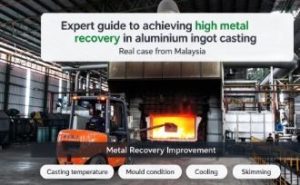
Step 5: Improve Mould Condition and Cooling
Worn moulds cause sticking, surface defects, and rejected ingots. Poor cooling causes cracks and internal porosity.
At the Malaysian plant, the moulds were worn and the cooling water temperature was 43°C. The target is 30–35°C.
We implemented a daily mould cleaning routine. We replaced the worst moulds. We cleaned the cooling spray nozzles and installed a water chiller to maintain temperature at 33°C.
Cost: $3,200 for new moulds, $4,800 for the chiller.
The result: surface rejection dropped by 60%. Cracks dropped by 80%.
Step 6: Reduce Hydrogen Content
Hydrogen causes surface pinholes and internal porosity. Both lead to rejected ingots. Rejected ingots are remelted, and every remelt loses metal.
At the Malaysian plant, the hydrogen content was 0.24 ml/100g Al. The target for surface-critical ingots is below 0.15 ml/100g.
We installed a rotary degasser with argon. The parameters:
| Parameter | Setting |
|---|---|
| Rotor speed | 600 rpm |
| Argon flow rate | 18 L/min |
| Degassing time | 8 minutes per 500 kg batch |
| Gas purity | 99.99% argon |
We also installed a portable hydrogen analyser. The operator measures hydrogen before every pour.
Cost: $9,500 for the degasser and analyser.
The result: hydrogen dropped to 0.11 ml/100g. Surface pinholes dropped by 85%.
Step 7: Pre-Dry Scrap
Wet scrap causes steam explosions, thermal shock, and hydrogen pickup. It also absorbs heat, increasing energy consumption.
At the Malaysian plant, scrap was stored outdoors. After rain, it was charged wet. We built a covered drying rack. We also installed a simple scrap preheater using waste heat from the furnace exhaust.
Cost: $2,000 for the drying rack and preheater.
The result: no more wet charging. Hydrogen pickup reduced. Metal recovery improved by 1%.
Step 8: Train Operators and Measure Everything
Most metal loss is caused by operator habits. Wet scrap. Overcharging. Excessive skimming. Running too hot. Leaving the door open.
We trained all operators on the new procedures:
-
Target holding furnace temperature: 695°C
-
Target tundish temperature: 715°C
-
Skimming frequency: every 45 minutes
-
Hydrogen target: below 0.15 ml/100g
-
Mould cleaning: every shift
-
Cooling water temperature: 33°C
-
Scrap must be dry before charging
We also started measuring metal recovery every shift. We track recovery per furnace, per shift, and per scrap type. The operators now see the results of their work.
Cost: $2,500 for training and measurement system.
The Results After One Month
| Metric | Before | After | Improvement |
|---|---|---|---|
| Metal recovery | 82% | 91% | 9% improvement |
| Dross metal content | 44% | 26% | 18% reduction |
| Tundish temperature | 682°C | 715°C | 33°C higher |
| Hydrogen content | 0.24 ml/100g | 0.11 ml/100g | 54% reduction |
| Surface rejection | 8.0% | 2.1% | 74% reduction |
| Energy consumption | 920 kWh/t | 785 kWh/t | 15% reduction |
| Annual metal savings | — | $2,100,000 | — |
| Investment | — | $37,200 | Payback: <1 week |
The plant manager was stunned. He had been ready to buy a new casting line. He didn’t need one. He needed to fix the process.
What Made the Difference
Three things drove the improvement:
1. Transfer and temperature control. Shortening the transfer, covering the launder, and raising tundish temperature eliminated cold shuts and reduced oxidation.
2. Skimming and dross processing. Skimming less often and using a dross press recovered metal that was previously thrown away.
3. Hydrogen control. Rotary degassing with measurement reduced hydrogen from 0.24 to 0.11 ml/100g. Surface pinholes disappeared. Rejected ingots were reduced.
I have written about how to improve metal recovery in aluminium scrap melting and how to improve aluminium ingot surface quality through better melting practices. Both are directly relevant to this case.
A Simple Checklist for High Metal Recovery in Ingot Casting
-
Shorten transfer distance. Cover and heat the launder.
-
Set holding furnace temperature to 680–700°C for ADC12.
-
Set tundish temperature to 710–720°C for 6 kg ingots.
-
Skim every 45 minutes, not every 20.
-
Use a perforated skimming tool. Install a dross press.
-
Measure hydrogen. Target below 0.15 ml/100g.
-
Clean moulds daily. Replace worn moulds.
-
Control cooling water temperature at 30–35°C.
-
Pre-dry scrap. Build a covered drying rack.
-
Train operators. Measure recovery every shift.
When to Call an Expert
You can measure these things yourself. A pyrometer, a hydrogen analyser, and a scale will tell you most of what you need to know. But sometimes an experienced eye sees the system, not just the components.
The Malaysian plant had a competent maintenance team. They had kept the casting line running for years. But they had never been trained on hydrogen measurement, transfer temperature control, or dross processing. They did not know what they did not know.
My fee for the six-day audit and commissioning support was $13,500. The annual saving was $2.1 million. That is a 155x return.
If your metal recovery is below 88%, call someone. Or use the checklists on this blog. Either way, do not wait.
Final Thoughts
Achieving high metal recovery in ingot casting is not about buying a new furnace or a new casting line. It is about controlling temperature, skimming practice, hydrogen, and mould condition. It is about measuring what you lose and training your people to lose less.
In my 25 years, I have seen plants recover millions by making small changes to their process. The furnace did not change. The people did.
If you run a recycling plant, start by measuring your metal recovery and dross metal content. If either is out of specification, fix it. You will see the difference in your profit.
Internal links: How to Reduce Metal Loss in Secondary Aluminium Melting for Ingot Production, How to Improve Aluminium Ingot Surface Quality Through Better Melting Practices, Case Study – How a Chinese Expert Optimized an Aluminium Ingot Casting Line in Malaysia