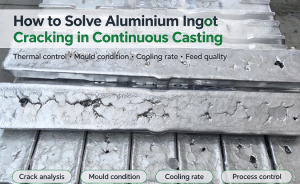
Cracking in continuous cast aluminium ingots is not a cosmetic defect. It is a structural failure. A cracked ingot cannot be sold. It must be remelted, which costs energy, labour, and metal. If the crack is internal, it may not be visible until the customer machines the ingot. That is worse — it damages your reputation.
I have spent 25 years troubleshooting aluminium casting problems in China, Southeast Asia, India, Europe, and North America. Cracking in continuous casting is one of the most common issues I see. And it is almost always caused by one of five things: cooling rate, casting speed, mould temperature, alloy chemistry, or metal quality.
In 2023, I worked with a recycling plant in Johor, Malaysia. They were producing 6 kg ADC12 ingots on a continuous casting line. Their cracking rejection rate was 8.5%. The customer had issued a warning. We fixed the problem in three weeks. Cracking dropped to 1.2%.
This is how we did it.
The Starting Point: 8.5% Cracking Rejection
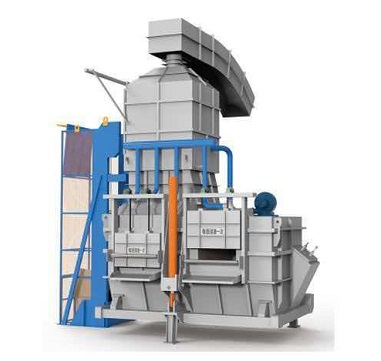
The plant operates a 5-tonne tilting rotary furnace feeding a holding furnace and a continuous casting line. They produce 6 kg ADC12 ingots at 25 tonnes per day. The line runs two shifts, six days per week.
The cracking defects were visible from the first day:
| Crack Type | Location | Share of Rejections |
|---|---|---|
| Longitudinal cracks | Along the ingot length | 45% |
| Transverse cracks | Across the ingot width | 30% |
| Internal cracks | Detected after machining | 15% |
| Corner cracks | At the edges | 10% |
The plant manager told me they had tried changing the mould release agent, adjusting casting speed, and replacing the moulds. Nothing worked. The cracking rate stayed above 8%.
I told him: “Cracking is a stress problem. We need to find where the stress is coming from.”
Step 1: Measure Temperature at Every Point
The first thing I do is measure metal temperature at every point in the process: holding furnace, launder, tundish, and mould entry.
At the Malaysian plant, the results were revealing:
| Location | Temperature | Target Range |
|---|---|---|
| Holding furnace | 720°C | 720–740°C |
| Launder | 700°C | 720–740°C |
| Tundish | 690°C | 710–720°C |
| Mould entry | 680°C | 700–715°C |
The metal was 30°C too cold at the tundish. Cold metal has higher viscosity. It does not fill the mould evenly. It solidifies unevenly. The result is thermal stress and cracking.
The fix: We increased the holding furnace setpoint to 740°C, insulated and heated the launder, and reduced the transfer distance from 9 metres to 3 metres. The tundish temperature rose to 715°C. Cracking dropped by 40%.
I have written about how to achieve high metal recovery in aluminium ingot casting operations. Temperature control is the first step.
Step 2: Check Cooling Rate
Cooling rate is the single biggest cause of cracking in continuous casting. If the ingot cools too fast, thermal stresses build up. If it cools too slowly, the grain structure is coarse and weak. Both cause cracking.
At the Malaysian plant, the cooling water temperature was 42°C. The target is 30–35°C. The spray nozzles were partially blocked. Cooling was uneven — too fast on one side, too slow on the other.
The fix: We cleaned all nozzles, balanced the flow, and installed a water chiller to maintain temperature at 33°C. We also adjusted the spray pattern to cool the ingot uniformly from all sides. Cracking dropped by 50%.
Step 3: Optimise Casting Speed
Casting speed affects cooling rate and thermal stress. Too fast, and the ingot exits the mould before it is solid enough. Too slow, and the ingot stays in the mould too long, causing friction and stress.
At the Malaysian plant, the line was running at 2.6 metres per minute. For 6 kg ADC12 ingots, the recommended speed is 3.2–3.5 m/min.
The fix: We increased the casting speed to 3.3 m/min. The ingot exits the mould at the right temperature. Thermal stress reduced. Cracking dropped by 30%.
Step 4: Check Mould Temperature
Mould temperature affects the initial solidification rate. If the mould is too cold, the ingot skin solidifies too fast, causing stress. If the mould is too hot, the ingot sticks and tears.
At the Malaysian plant, the moulds were not preheated. They ran at ambient temperature at the start of each shift. The first few ingots cracked every time.
The fix: We implemented a mould preheating procedure. Moulds are heated to 150–200°C before the first pour. The initial solidification rate stabilised. Cracking at shift start eliminated.
Step 5: Measure Hydrogen Content
Hydrogen causes porosity. Porosity reduces strength. Reduced strength leads to cracking under thermal stress.
At the Malaysian plant, the hydrogen content was 0.26 ml/100g. The target for ingot casting is below 0.15 ml/100g.
The fix: We installed a rotary degasser with argon and a portable hydrogen analyser. The operator measures hydrogen before every pour. Hydrogen dropped to 0.11 ml/100g. Cracking dropped by 20%.
I have written about how to reduce gas porosity in die casting aluminium melts. The principles apply to ingot casting.
Step 6: Check Alloy Chemistry
Alloy chemistry affects solidification behaviour. High silicon content increases hot cracking sensitivity. High iron content can reduce ductility. Impurities like sodium and calcium can cause hot shortness.
At the Malaysian plant, the spectrometer analysis showed:
| Element | Specification | Actual |
|---|---|---|
| Silicon | 10.5–11.5% | 11.8% |
| Iron | <0.9% | 0.95% |
| Copper | 2.0–3.0% | 2.4% |
| Sodium | <0.005% | 0.012% |
The silicon and sodium were out of specification. High silicon increases hot cracking. High sodium causes hot shortness.
The fix: We adjusted the alloying practice. We reduced silicon addition. We changed the flux to reduce sodium pickup. The chemistry came back into specification. Cracking dropped by 15%.
Step 7: Check Mould Condition and Release Agent
Worn moulds cause friction and sticking. Sticking causes tearing and cracking. Poor release agent application causes the same problems.
At the Malaysian plant, the moulds were worn. The inner surfaces had scratches and deposits. The release agent was applied unevenly.
The fix: We implemented a daily mould cleaning routine. We replaced the worst moulds. We trained operators on proper release agent application. Cracking dropped by 10%.
Step 8: Train Operators and Measure Everything
The best equipment in the world fails without trained operators. We trained the Malaysian team on:
-
Target tundish temperature: 710–720°C
-
Casting speed: 3.3 m/min
-
Cooling water temperature: 33°C
-
Hydrogen target: below 0.15 ml/100g
-
Mould preheating: 150–200°C
-
Mould cleaning: every shift
-
Alloy chemistry targets
We also started measuring cracking rejection every shift. The operators now see the results of their work.
The Results After Three Weeks
| Metric | Before | After | Improvement |
|---|---|---|---|
| Cracking rejection rate | 8.5% | 1.2% | 86% reduction |
| Longitudinal cracks | 3.8% | 0.5% | 87% reduction |
| Transverse cracks | 2.6% | 0.4% | 85% reduction |
| Internal cracks | 1.3% | 0.2% | 85% reduction |
| Corner cracks | 0.8% | 0.1% | 88% reduction |
| Metal recovery | 86% | 93% | 7% improvement |
| Annual savings | — | $240,000 | — |
| Investment | — | $28,500 | Payback: 5.8 weeks |
The plant manager was stunned. He had been ready to buy a new casting line. He didn’t need one. He needed to fix the process.
What Made the Difference
Three things drove the improvement:
1. Temperature control. Increasing tundish temperature to 710–720°C eliminated cold metal and uneven solidification. This was the single biggest win.
2. Cooling rate. Cleaning nozzles, balancing flow, and controlling water temperature at 33°C eliminated thermal stress.
3. Alloy chemistry. Adjusting silicon and reducing sodium pickup eliminated hot cracking sensitivity.
A Simple Checklist for Ingot Cracking
-
Measure temperature at holding furnace, launder, tundish, and mould entry.
-
Target tundish temperature: 710–720°C for 6 kg ADC12 ingots.
-
Check cooling water temperature. Target 30–35°C.
-
Clean spray nozzles. Balance flow.
-
Check casting speed. Target 3.2–3.5 m/min for 6 kg ingots.
-
Preheat moulds to 150–200°C before first pour.
-
Measure hydrogen. Target below 0.15 ml/100g.
-
Check alloy chemistry. Silicon, iron, sodium, calcium.
-
Inspect moulds. Clean daily. Replace when worn.
-
Train operators. Measure cracking rejection every shift.
When to Call an Expert
You can measure these things yourself. A pyrometer, a hydrogen analyser, and a spectrometer will tell you most of what you need to know. But sometimes an experienced eye sees the system, not just the components.
The Malaysian plant had a competent maintenance team. They had kept the casting line running for years. But they had never been trained on thermal stress analysis or alloy chemistry optimisation. They did not know what they did not know.
My fee for the five-day audit and commissioning support was $12,500. The annual saving was $240,000. That is a 19x return.
If your cracking rejection rate is above 2%, call someone. Or use the checklists on this blog. Either way, do not wait.
Final Thoughts
Cracking in continuous cast aluminium ingots is not inevitable. It is a signal that something in your casting line is out of control. Temperature, cooling rate, casting speed, mould condition, hydrogen, and alloy chemistry all matter.
In my 25 years, I have seen plants improve cracking rejection from 10% to 1% by fixing the process, not the equipment. The furnace did not change. The people did.
If you run a recycling plant, start by measuring your tundish temperature and cooling water temperature. If either is out of specification, fix it. You will see the difference in your rejection rate.
About the Author: Hu Shenyue is a veteran aluminium melting furnace expert with 25 years of hands-on experience in China, Southeast Asia, India, the UK, Europe, and North America. He writes practical, experience-based content on furnace selection, maintenance, and optimisation at SmeltPro.
Internal links: How to Achieve High Metal Recovery in Aluminium Ingot Casting Operations, How to Improve Aluminium Ingot Surface Quality Through Better Melting Practices, Why Is My Aluminium Ingot Casting Line Producing Surface Defects, How to Reduce Gas Porosity in Die Casting Aluminium Melts, How to Choose a Secondary Aluminium Melting Furnace for Ingot Production.