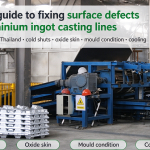
I want to tell you about a recycling plant in Thailand that was losing 11% of its ingot production to surface defects. They had tried everything: new moulds, new release agent, different casting speeds. Nothing worked.
The problem was the cooling system. Not broken. Just neglected. The spray nozzles were partially blocked. The water temperature was 43°C instead of 33°C. The flow was uneven across the mould width. The ingots cooled unevenly. They cracked. They had surface porosity. They failed inspection.
We cleaned the nozzles, installed a chiller, and balanced the flow. The rejection rate dropped from 11% to 1.8% in one month.
This article is about cooling system failures on aluminium ingot casting lines. Not the textbook causes. The failures I actually find.
What the Cooling System Does
On an ingot casting line, the cooling system controls how fast the metal solidifies. If cooling is too slow, the ingot has a coarse grain structure and surface porosity. If cooling is too fast, thermal stresses build up and the ingot cracks. If cooling is uneven, the ingot warps or develops internal stresses.
The cooling system has three jobs:
-
Extract heat from the molten metal at the right rate
-
Maintain uniform temperature across the mould
-
Adapt to different alloys and ingot sizes
When any of these fail, the ingot quality fails.
Failure 1: Water Temperature Is Too High
This is the most common failure I find. The cooling water absorbs heat from the ingots. If the water is not cooled, its temperature rises. The cooling rate drops. The ingots solidify too slowly.
What to check: Measure the water temperature at the inlet to the mould. For aluminium ingot casting, the target is 30–35°C. If it is above 38°C, you have a problem.
At the Thai plant, the water temperature was 43°C. The plant had no chiller. The water was recirculated from a holding tank. The tank was undersized. The water heated up during the day. The last ingots of each shift had different properties than the first.
We installed a simple water chiller. The temperature stabilised at 33°C. The rejection rate dropped immediately.
The fix: Install a chiller. Size it for the heat load. Maintain water temperature at 30–35°C.
Failure 2: Spray Nozzles Are Blocked
The spray nozzles distribute water across the mould surface. If they are blocked, the cooling is uneven. Some areas cool too fast. Others cool too slow. The ingot develops stresses.
What to check: Inspect the spray pattern. It should be uniform and full. If you see gaps or weak spots, the nozzles are partially blocked.
At the Thai plant, we removed the nozzles and soaked them in descaling solution. The blockage was calcium carbonate from hard water. We also installed a water softener to prevent recurrence.
The fix: Clean nozzles monthly. Install a water filter. Use softened water if hardness is high.
Failure 3: Water Flow Is Uneven
Even if the nozzles are clean, the flow can be uneven. The manifold may be undersized. The piping may be routed poorly. The pump may be worn.
What to check: Measure the flow at each nozzle. Compare. If the variation is more than 10%, you have a flow problem.
At the Thai plant, the manifold was undersized. The nozzles at the end of the line received less water than the nozzles at the beginning. The ingots at the end of the line cooled slower. They had different properties.
We replaced the manifold with a larger one and balanced the flow. The variation dropped to 3%.
The fix: Measure flow at each nozzle. Balance the system. Replace undersized manifolds.
Failure 4: The Pump Is Worn
The cooling water pump wears over time. The impeller erodes. The flow rate drops. The pressure drops. The cooling capacity drops.
What to check: Measure the pump output. Compare with the design specification. If it is below 90% of design, the pump is worn.
At a plant in Malaysia, the pump had been in service for eight years. The flow was 30% below design. The ingots were cooling too slowly. We replaced the pump. The cooling rate returned to normal.
The fix: Monitor pump performance. Replace when output drops below 90% of design.
Failure 5: The Cooling Water Is Contaminated
Dirty water causes blockages. It also reduces heat transfer. If the water contains oil or scale, the cooling efficiency drops.
What to check: Look at the water. Is it clear? Is there oil sheen? Is there sediment? Check the filter. If it is clogged, the water is dirty.
At a plant in Vietnam, the cooling water was contaminated with hydraulic oil from a leaking cylinder. The oil coated the mould surface. The heat transfer dropped. The ingots developed surface defects.
We fixed the leak, flushed the system, and installed an oil-water separator. The problem was solved.
The fix: Keep the water clean. Fix leaks. Install filtration.
Failure 6: The Mould Is Not Preheated
If the mould is cold at the start of the shift, the first ingots cool too fast. They crack. This is a common cause of start-up rejection.
What to check: Measure the mould temperature at the start of the shift. It should be 150–200°C before the first pour.
At a plant in Indonesia, the moulds were at ambient temperature at the start of each shift. The first five ingots cracked every time. We implemented a mould preheating procedure using a simple gas torch. The problem was solved.
The fix: Preheat moulds before the first pour. Use a gas torch or electrical heater.
Failure 7: The Cooling Rate Is Wrong for the Alloy
Different alloys have different solidification characteristics. A cooling rate that works for one alloy may not work for another.
What to check: Review the cooling parameters for each alloy you cast. If you are running multiple alloys on the same line, you may need different cooling settings.
At a plant in Thailand, they were running ADC12 and A356 on the same line. The cooling settings were optimised for ADC12. The A356 ingots cracked because the cooling was too fast.
We developed alloy-specific cooling recipes. The operator selects the recipe when changing alloys. The cracking stopped.
The fix: Develop alloy-specific cooling recipes. Train operators to use them.
A Real Case from Thailand
Let me give you the numbers from that plant.
Before:
-
Water temperature: 43°C
-
Nozzle condition: 40% blocked
-
Flow variation: 15%
-
Pump output: 85% of design
-
Mould preheat: None
-
Surface rejection: 11%
After:
-
Water temperature: 33°C
-
Nozzle condition: Clean
-
Flow variation: 3%
-
Pump output: 100% of design
-
Mould preheat: 180°C
-
Surface rejection: 1.8%
Investment: $26,900
**Annual saving:** $210,000
Payback: 6.4 weeks
A Simple Cooling System Checklist
-
Measure water temperature. Target 30–35°C. Install chiller if higher.
-
Inspect spray nozzles. Clean monthly. Install filter.
-
Measure flow at each nozzle. Balance if variation >10%.
-
Check pump output. Replace if below 90% of design.
-
Check water quality. Fix leaks. Install oil-water separator.
-
Preheat moulds. Target 150–200°C before first pour.
-
Develop alloy-specific cooling recipes.
-
Train operators. On cooling parameters and troubleshooting.
When to Call Someone
Cooling system problems are often misdiagnosed as mould problems or alloy problems. If you have tried changing moulds and release agents without success, check the cooling system.
If your rejection rate is above 3%, and you have not audited your cooling system in the last six months, call someone. Or use this checklist.
Final Thoughts
Cooling system failures on aluminium ingot casting lines are not mysterious. They are temperature, flow, cleanliness, and preheat.
The Thai plant went from 11% rejection to 1.8% by fixing the cooling system. Not by buying a new line. By paying attention.
Check your water temperature first. Then check your nozzles. Then check your flow. You will find the problem.
About the Author: Hu Shenyue is a veteran aluminium melting furnace expert with 25 years of hands-on experience in China, Southeast Asia, India, the UK, Europe, and North America. He writes practical, experience-based content on furnace selection, maintenance, and optimisation at SmeltPro.
Internal links: Why Is My Aluminium Ingot Casting Line Producing Surface Defects, How to Solve Aluminium Ingot Cracking Problems in Continuous Casting, How to Achieve High Metal Recovery in Aluminium Ingot Casting Operations, How to Choose a Secondary Aluminium Melting Furnace for Ingot Production, Case Study – How a Chinese Expert Solved Ingot Surface Quality Issues in Thailand.