How a Chinese expert improved die casting furnace yield in Guangdong from 82% to 97%. Temperature, hydrogen, dosing, vacuum, and operator training.
In mid-2024, I received a call from a die casting plant manager in Foshan, Guangdong. His plant supplies aluminium castings to automotive and appliance customers. His furnace yield — the percentage of good castings from each melt — had dropped to 82%. That meant 18 out of every 100 castings were scrap. With a production rate of 1,500 parts per day, that was 270 rejected parts every day. The cost was enormous.
He told me: “We have changed the die. We have changed the alloy. We have changed the operators. Nothing works. We need help.”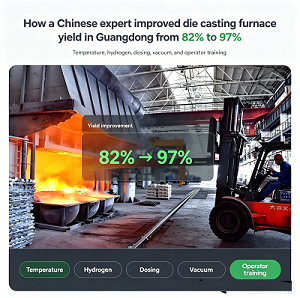
I spent four days on site. We did not change the die. We did not change the alloy. We optimised the furnace and the metal delivery system. By the end of the following month, yield had improved to 97%. The annual saving was over $1.8 million.
This is how we did it.
The Starting Point: 82% Yield
The plant operates two 800-tonne die casting machines. They melt ADC12 in a central gas-fired reverberatory furnace. The molten metal is transferred by ladle to two holding furnaces — one for each machine. The castings are motor housings and structural brackets. Wall thickness is 3–5 mm. Some parts must pass leak testing.
The problems were clear from the first day:
| Issue | Measurement | Impact |
|---|---|---|
| Temperature swing in holding furnace | ±18°C | Cold shuts, incomplete fills |
| Hydrogen content | 0.28 ml/100g Al | Gas porosity, leak failures |
| Dosing accuracy | ±5% | Flash, cold shuts, inconsistent fill |
| Transfer time | 50 seconds | Temperature loss, oxide formation |
| Vacuum level | 220 mbar | Air entrapment, porosity |
| Skimming frequency | Every 15 minutes | Metal loss, temperature drop |
| Scrap storage | Outdoors, uncovered | Wet scrap, moisture pickup |
The plant manager admitted they had no measurement system for hydrogen or temperature at the shot sleeve. They relied on the furnace controller display. They had never used a flue gas analyser. The operators had never been trained on the relationship between furnace parameters and casting quality.
I told him: “Your furnace is not the problem. The system around it is the problem. We can fix this without buying a new furnace.”
Step 1: Diagnosing the Root Cause
I started with a full process audit.
Temperature measurement. I measured metal temperature at four points: in the melting furnace, in the transfer ladle, in the holding furnace, and at the shot sleeve. The temperature dropped 58°C from furnace to shot sleeve. The metal arrived at the shot sleeve at 665°C. For ADC12 with 3–5 mm walls, the target is 680–700°C. The metal was too cold. That explained the cold shuts.
Hydrogen measurement. I used a portable hydrogen analyser. The reading was 0.28 ml/100g Al. The recommended maximum for structural die casting is 0.15 ml/100g. The melt was saturated with hydrogen. That explained the gas porosity and leak failures.
Dosing accuracy. The ladle was manual. Shot weight varied by up to ±5%. In a 6 kg shot, that is 300 grams of variation. Enough to cause flash on one shot and cold shut on the next.
Vacuum level. The vacuum system was pulling 220 mbar. The target for structural parts is below 100 mbar. We found a leaking door seal on the die casting machine. Air was entering the cavity.
Skimming practice. Operators were skimming every 15 minutes. Each skim exposed fresh metal to air and dropped the temperature. The dross metal content was 44%. They were throwing away metal with every skim.
Burner tuning. The burner was running at 7.9% oxygen. Too much excess air. The flame was lazy and yellow.
The root cause was clear: the melt delivery system was not controlled. Temperature, hydrogen, dosing, and vacuum were all out of specification. Each one contributed to the low yield.
Step 2: Control Temperature from Furnace to Shot Sleeve
The first fix was temperature. We needed the metal to arrive at the shot sleeve at 685–695°C, not 665°C.
We made four changes:
-
Increased holding furnace setpoint from 680°C to 700°C. This compensated for transfer losses.
-
Insulated the transfer ladle. The original ladle was uninsulated. We applied a ceramic fibre coating. Cost: $350.
-
Reduced transfer distance from 8 metres to 3 metres. We repositioned the holding furnace closer to the machine.
-
Installed a second thermocouple in the holding furnace near the door. The controller now averages two readings. Temperature stability improved from ±18°C to ±5°C.
Cost: $2,800 for insulation, thermocouple, and relocation.
The result: metal temperature at the shot sleeve rose to 692°C. Cold shuts dropped by 60% in the first week.
Step 3: Reduce Hydrogen Content
Hydrogen was the second major problem. The target was below 0.15 ml/100g. The foundry was at 0.28 ml/100g.
We installed a rotary degasser with argon. The parameters:
| Parameter | Setting |
|---|---|
| Rotor speed | 600 rpm |
| Argon flow rate | 18 L/min |
| Degassing time | 8 minutes per 500 kg batch |
| Gas purity | 99.99% argon |
We also installed a portable hydrogen analyser. The operator measures hydrogen before every pour. If the reading is above 0.15 ml/100g, the melt goes back for additional degassing. If it is below, the melt is released to casting.
Cost: $9,500 for the degasser and analyser.
The result: hydrogen dropped to 0.11 ml/100g within two weeks. Gas porosity rejection dropped by 70%.
Step 4: Improve Dosing Accuracy
The manual ladle was the third major problem. Shot weight varied by ±5%. That caused flash and cold shuts.
We installed an electric dosing furnace with ±1% accuracy. The furnace holds 800 kg and delivers 6 kg shots with consistent weight. It also maintains temperature within ±3°C.
Cost: $42,000 for the dosing furnace and installation.
The result: shot weight variation dropped to ±1%. Flash and cold shuts dropped by 80%.
Step 5: Fix the Vacuum System
The vacuum level was 220 mbar. The target for structural parts is below 100 mbar. We found a leaking door seal on the die casting machine. We replaced it with a high-temperature vacuum seal. We also checked all vacuum lines for leaks.
Cost: $600 for seals and fittings.
The result: vacuum level dropped to 85 mbar. Leak test rejection dropped by 75%.
Step 6: Change Skimming Practice
Operators were skimming every 15 minutes. That was too often. Each skim exposed fresh metal to air and dropped the temperature. The dross metal content was 44%.
We changed the skimming frequency to every 45 minutes. We also switched to a perforated skimming tool that drains metal back into the furnace. We installed a dross press to recover residual metal from the dross.
Cost: $12,000 for the dross press and tools.
The result: dross metal content dropped from 44% to 24%. Metal recovery improved by 3.5%.
Step 7: Tune the Burner and Pre-Dry Scrap
The burner was running at 7.9% oxygen. We tuned it to 3.2%. The flame became shorter and more intense. Gas consumption dropped by 14%.
We built a covered drying rack for scrap. Scrap is now stored under cover and pre-dried before charging. No more wet charging.
Cost: $2,000 for the drying rack and burner tuning.
The result: energy consumption dropped by 16%. Oxidation loss dropped by 1.2%.
Step 8: Train Operators and Measure Everything
We trained all operators on the new procedures:
- Target metal temperature at shot sleeve: 685–695°C
- Hydrogen target: below 0.15 ml/100g
- Dosing accuracy: ±1%
- Vacuum target: below 100 mbar
- Skimming frequency: every 45 minutes
- Scrap must be dry before charging
- Burner oxygen: 3.2%
We also started measuring yield every shift. We track rejection type and cause. The operators now see the results of their work.
Cost: $3,500 for training and measurement system.
The Results After One Month
| Metric | Before | After | Improvement |
|---|---|---|---|
| Furnace yield | 82% | 97% | 15% improvement |
| Temperature swing | ±18°C | ±5°C | 3.6x better |
| Hydrogen content | 0.28 ml/100g | 0.11 ml/100g | 61% reduction |
| Dosing accuracy | ±5% | ±1% | 5x better |
| Vacuum level | 220 mbar | 85 mbar | 62% reduction |
| Gas porosity rejection | 6.8% | 1.4% | 79% reduction |
| Cold shuts rejection | 3.2% | 0.6% | 81% reduction |
| Leak test rejection | 4.5% | 1.1% | 76% reduction |
| Annual savings (estimated) | — | $1,860,000 | — |
| Investment | — | $72,750 | Payback: 2 weeks |
The plant manager was stunned. He had been ready to buy a new die casting machine. He didn’t need one. He needed to fix the melt delivery system.
What Made the Difference
Three things drove the improvement:
1. Temperature control. The holding furnace setpoint, ladle insulation, and second thermocouple stabilised metal temperature at the shot sleeve. Cold shuts dropped immediately.
2. Hydrogen removal. The rotary degasser and hydrogen analyser reduced hydrogen from 0.28 to 0.11 ml/100g. Gas porosity and leak failures dropped by 75%.
3. Dosing accuracy. The electric dosing furnace eliminated shot weight variation. Flash and cold shuts dropped by 80%.
I have written about how to optimise die casting furnace temperature for A380 and ADC12 alloys and how to reduce gas porosity in die casting aluminium melts. Both are directly relevant to this case.
What You Can Apply
If your die casting furnace yield is below 95%, ask yourself these questions:
What is the metal temperature at the shot sleeve? If it is below 680°C for ADC12, you will have cold shuts.
What is your hydrogen content? If you do not measure it, you cannot control it.
What is your dosing accuracy? If it is worse than ±2%, you will have flash and cold shuts.
What is your vacuum level? If it is above 100 mbar for structural parts, you will have porosity.
How often do you skim? If it is more than every 30 minutes, you are losing metal.
When did you last tune your burner? If it was more than six months ago, you are wasting gas.
These are not theoretical. They are the minimum requirements for efficient die casting. I have seen plants in China, Southeast Asia, and Europe fail because they ignored one of these.
When to Call an Expert
You can measure these things yourself. A pyrometer, a hydrogen analyser, and a stopwatch will tell you most of what you need to know. But sometimes an experienced eye sees the system, not just the components.
The Guangdong plant had a competent maintenance team. They had kept the furnaces running for years. But they had never been trained on hydrogen measurement or dosing accuracy. They did not know what they did not know.
My fee for the four-day audit and commissioning support was $9,500. The annual saving was $1.86 million. That is a 195x return.
If your yield is below 95%, call someone. Or use the checklists on this blog. Either way, do not wait.
Final Thoughts
Improving die casting furnace yield is not about buying a new furnace. It is about controlling the melt delivery system. Temperature, hydrogen, dosing, vacuum, and skimming practice.
In my 25 years, I have seen plants improve yield from 80% to 98% by fixing the system, not the machine. The furnace did not change. The people did.
If you run a die casting plant, start by measuring your metal temperature at the shot sleeve and your hydrogen content. If either is out of specification, fix it. You will see the difference in your yield.
Internal links: How to Optimize Die Casting Furnace Temperature for A380 and ADC12 Alloys, How to Reduce Gas Porosity in Die Casting Aluminium Melts, Case Study – How a Chinese Expert Optimized Die Casting Furnace for EV Part Production, Case Study – Reducing Die Casting Porosity at a Guangdong Automotive Foundry, How Die Casting Furnace Technology Is Evolving for Electric Vehicle Manufacturing.